AI-powered community news covering local government, public meetings, and community issues across Alaska.
Alaska
House Finance sets amendment deadline for police, firefighter disability bill | Alaska News | Alaska News
House Finance sets amendment deadline for police, firefighter disability bill
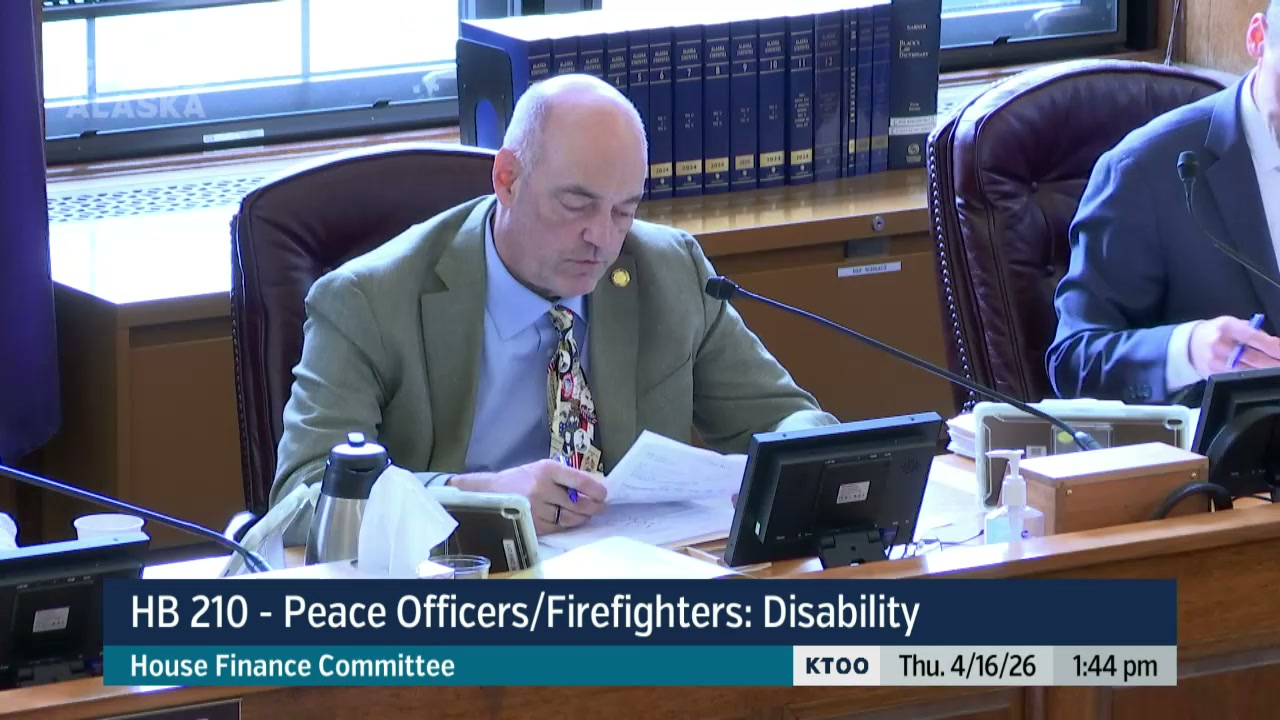
Frame from "House Finance, 4/16/26, 1:30pm" · Source
PublishedAI
House Finance sets amendment deadline for police, firefighter disability bill
by Alaska NewsApr 17, 2026(2w ago)6 min readAlaska
Share
The House Finance Committee on Thursday set an amendment deadline for legislation that would increase disability benefits for permanently injured peace officers and firefighters, while also advancing a mail theft bill and introducing a revised paid parental leave measure.
The committee heard House Bill 210, sponsored by Rep. Kopp, R-Anchorage. The bill would raise disability payments for peace officers and firefighters from 40 percent to 75 percent of their final salary. Under the bill, officers would remain at 40 percent during the first year of disability, then increase to 75 percent in the second year and beyond. The bill applies to those in the defined contribution retirement system who suffer permanent career-ending injuries in the line of duty.
"House Bill 210 addresses a gap in how we support peace officers and firefighters who suffer permanent career-ending injuries in the line of duty," Kopp said. "Today those individuals receive just 40 percent of their salary, or a 60 percent income loss overnight after the disability occurs. And that loss is compounding because most of those employees also lose their employee-sponsored healthcare, because you can only have your employee-sponsored healthcare if you are not on disability."
The bill would affect 12 peace officers and firefighters currently on disability status, according to Kopp. There are 16 total public safety officers in the defined contribution plan on occupational disability, but only 12 are peace officers and firefighters covered by the legislation. The disability trust fund that would cover the increased payments is currently funded at 421 percent, he said.
Brandon Rumsfeld, retirement manager for the Division of Retirement and Benefits, submitted a zero fiscal note but noted the department anticipates programming costs to implement the legislation. Those costs are not yet known, he said.
Several committee members raised questions about differences between the defined benefit and defined contribution retirement plans, particularly regarding healthcare coverage and disability definitions. Rep. Bynum, R-Ketchikan, asked whether the bill should be expanded to include other employees in the Public Employees' Retirement System who work in high-risk jobs, citing linemen as an example.
When Rep. Josephson, D-Juneau, asked what the bill does about healthcare for disabled officers, Kopp acknowledged the legislation does not address that gap. "The healthcare plan is a cost driver. And we did not know how that would impact this bill," Kopp said. "We tackled the immediate relief we could give them, which was the disability, because the trust is so well funded and there are few members that this would apply to. And the most immediate relief we could give them is this cash payment relief going from 40 to 75 percent. But again, it does not address the healthcare problem."
This article was drafted with AI assistance and reviewed by editors before publishing. Every claim can be verified against the original transcript. If you spot an error, let us know.
Kopp said the bill addresses concerns brought forward by public safety employees about the significant financial impact of losing 60 percent of their salary and healthcare coverage. He noted that even with the increase to 75 percent, many disabled officers would still fall just above the Medicaid threshold, leaving them without affordable healthcare options.
Rep. Hannan, D-Juneau, asked about the timeline for the Division of Retirement and Benefits' computer programming changes. Rumsfeld said he would need to follow up with the team working on the system modernization project to provide a completion date.
Rep. Galvin, D-Anchorage, questioned whether the 16 individuals affected would create programming challenges. Rumsfeld said the division does not anticipate problems, but the programming has not yet been incorporated because the provision is not currently in statute.
The committee also discussed tax implications of increasing the disability benefit above 40 percent. Rep. Tomaszewski, R-Wasilla, asked whether raising the benefit beyond 40 percent would trigger tax liability that may have otherwise been nontaxable. Rumsfeld said he would need to research the question.
Rep. Tomaszewski said he plans to submit an amendment to increase the first-year disability payment to 75 percent rather than keeping it at 40 percent.
Co-Chair Neal Foster, D-Nome, set an amendment deadline of Thursday, April 23, 2026, at 5 p.m. He said the committee would schedule another hearing before that deadline to answer outstanding questions from members.
Mail Theft Bill
The committee also heard House Bill 77, sponsored by Rep. Coulombe, R-Anchorage, which establishes mail theft as a state crime classified as theft in the second degree, a Class C felony. The bill provides statutory definitions for mail-related terms and includes mail from private delivery companies.
Tiffany Loughman, a detective who brought the bill to Coulombe, said mail theft has increased significantly because law enforcement currently cannot prosecute cases where mail is stolen but not yet opened.
"When patrol stumbles across somebody at 2 o'clock in the morning with literally a car full of mail and it is not opened and we do not have an access device like a check or something with a number on it, we cannot do anything," Loughman said.
Brian Ranger, testifying as a private citizen with 21 years of law enforcement experience, said mail theft particularly affects elderly and vulnerable Alaskans who rely on the postal service for essential mail including Social Security benefits and prescription medications.
"Having this bill go through would just give law enforcement another tool in their tool belt to actually catch the folks that are doing this, hopefully before they actually commit the bank fraud and the check fraud and the ID theft," Ranger said.
Marge Stoneking, state director of advocacy for AARP Alaska, said the organization supports the bill because mail theft disproportionately affects older Alaskans.
"When mail is stolen, the result is often check fraud, identity theft, and long-lasting financial damage that can be extremely difficult to undo, not to mention the stress," Stoneking said.
Multiple state agencies submitted zero fiscal notes for the bill, including the Alaska Court System, the Office of Public Advocacy, the Public Defender Agency, the Department of Law, and the Department of Public Safety. Officials said while the bill may increase prosecutions, the number of additional cases is difficult to predict and agencies anticipate absorbing the workload within existing budgets.
Nancy Mead, general counsel for the Alaska Court System, said the penalty for a Class C felony is zero to five years, with a presumptive range of zero to two years for first-time offenders.
Several committee members expressed strong support for the bill. Rep. Ballard, R-Eagle River, said she wanted to move the bill immediately, while Rep. Tomaszewski, R-Wasilla, said he looked forward to advancing the legislation. At least one member indicated interest in offering an amendment before the deadline.
Foster set an amendment deadline of Monday, April 20, 2026, at noon for House Bill 77.
Paid Parental Leave Bill
The committee also adopted a committee substitute for House Bill 193, which addresses unemployment insurance benefits and creates a paid parental leave program. Joan Wilkerson, staff to sponsor Rep. Hall, D-Anchorage, said the changes in the new version are technical rather than policy-based and were made to ensure compliance with the Federal Unemployment Tax Act.
"The amendments ensure compliance with key federal laws," Wilkerson said. The revised bill removes employee contributions to the unemployment insurance program and creates a separate chapter in statute for the paid parental leave program.
Foster removed his objection to the committee substitute after discussion, and hearing no further objections, the committee adopted the new version as its working document. The committee held the bill for further work. Foster announced the committee would not meet Friday and would likely reconvene Monday at 1:30 p.m.
Stay informed. Support what matters.
Free, permanent access to local news you can verify. Subscribe to support Alaska News and go ad-free.

Comments
Sign in to leave a comment.
No comments yet. Be the first to share your thoughts.