AI-powered community news covering local government, public meetings, and community issues across Alaska.
Alaska
House Finance hears divided testimony on pharmacist prescribing bill | Alaska News
House Finance hears divided testimony on pharmacist prescribing bill
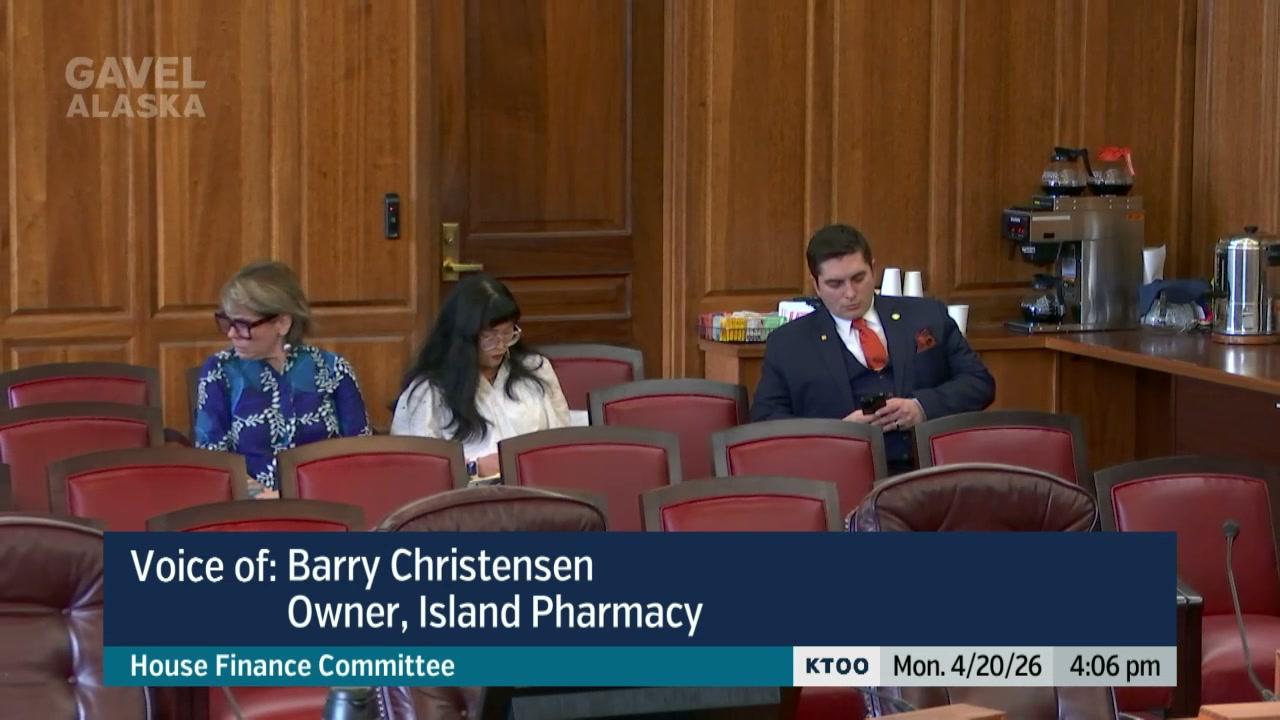
Frame from "House Finance, 4/20/26, 1:30pm" · Source
PublishedAI
House Finance hears divided testimony on pharmacist prescribing bill
by Alaska NewsMay 11, 2026(1h ago)5 min readHouse Finance
Share
JUNEAU — The Alaska House Finance Committee heard public testimony Monday on legislation that would expand pharmacists' ability to prescribe medications and provide patient care services. Supporters cited improved access to care. Opponents raised concerns about abortion medication.
The committee took testimony on House Bill 195 during an April 12 meeting. Chair Foster limited testimony to two minutes each because 34 people had signed up to testify on the measure, which builds on 2022 legislation that allowed pharmacists to practice at the top of their training.
What the Bill Does
The legislation would clarify that pharmacists can provide patient care services including independent prescriptive authority and direct patient care. Pharmacists would be able to test for and treat conditions like influenza, strep throat and urinary tract infections.
"This bill is about meeting patients where they are and reducing unnecessary delays in care," said Deborah Herron, representing Walmart's nine Alaska pharmacies. "It allows pharmacists to act when appropriate, refer when needed, and collaborate more effectively with physicians."
Representative Genevieve Mena, the bill's sponsor, said the measure is among policies included in Alaska's Rural Health Transformation Program. The Legislature would need to pass it to ensure the state keeps federal funding awarded through the program.
Support from Healthcare Providers
Multiple physicians testified in support. Dr. Dan Hartman, speaking for Southcentral Foundation, said the legislation would help the organization's dozens of pharmacists across urban and rural locations provide more accessible care.
"Pharmacists have the skills needed to appropriately use the authorities they would be given under the policy calls in this bill," Hartman said. He noted that at a time of workforce shortages, the legislation would expand the healthcare workforce that can take on certain care responsibilities.
Brittany Keener, a pharmacist leader within Alaska's tribal health system, said Alaska has received funding through the Federal Rural Health Transformation Program. She called it "a once-in-a-generation opportunity to strengthen our healthcare system."
Jane LeBlanc, a clinical pharmacist in Fairbanks, described seeing patients two to four weeks after their primary care visits to ensure progress on care plans. Most providers in her clinic have appointment wait times of six to eight weeks, she said.
"Fairbanks is not a rural community, but we suffer from many of the same problems that rural communities do, which is inability to get in to see primary care physicians in a timely manner," LeBlanc said.
This article was drafted with AI assistance and reviewed by editors before publishing. Every claim can be verified against the original transcript. If you spot an error, let us know.
Barry Christianson, a Ketchikan pharmacist whose family has operated Island Pharmacy since 1974, said his community now has one full-time primary care physician. That is down from approximately 10 when he started practicing in 1988.
"Pharmacists can help fill the gap where needed," Christianson said.
Multiple pharmacists emphasized they are among the most accessible healthcare professionals. They said similar authority exists in other states and federal systems such as the Indian Health Service and VA. Several noted the bill could help with pharmacist recruitment and retention in Alaska.
Pharmacists typically complete two to three years of undergraduate preparation followed by four years of professional doctorate-level training. Tom Wadsworth, dean of the UAA-ISU Doctor of Pharmacy program at the University of Alaska Anchorage, said graduates complete more than 2,000 hours of doctorate-level didactic training in physiology, pathophysiology, pharmacology and therapeutics. They also complete more than 1,700 hours of direct patient care with real patients.
"With this training, pharmacists really bring a distinct and specialized expertise to the healthcare team," Wadsworth said. "Our accrediting body requires us to graduate practice-ready pharmacists. This includes diagnostic clinical reasoning and independent prescribing within the pharmacy's scope of training."
Brittany Carnes, a Fairbanks pharmacist, said physicians regularly ask pharmacists to dose medications when they are uncertain.
"They come to us when they are stumped," Carnes said. "They know that we do know and we are usually able to help."
Concerns Raised About Abortion Medication
Several testifiers focused on concerns that the bill would expand access to mifepristone, a medication used to terminate pregnancies. Some callers cited statistics claiming 10 percent or 11 percent of women experience serious complications from the drug. Those figures were not independently verified during the hearing.
"Expanding mail-in abortion pills is too dangerous for women and their own unborn children," said Debbie Rathbun of Fairbanks, who grew up in remote Athabaskan villages. "Medical help is hours away for medical emergencies in rural Alaska."
Pat Martin, president of Alaska Right to Life, expressed concerns about collaborative practice agreements potentially allowing abortion medication prescribing. He called on the committee to amend the bill to prohibit pharmacists from prescribing or dispensing abortion-causing drugs.
Representative Bynum repeatedly asked testifiers whether they were aware of any community pharmacies currently dispensing mifepristone for abortion purposes. None said they were.
Pharmacists who testified said the drug cannot legally be dispensed by community pharmacies under current law. They said the Attorney General's office has determined the bill would not change that.
"Absolutely not," said Christianson when asked if his pharmacy could dispense the drug under the bill. "Even if my pharmacy wanted to do that, we are prevented from buying it."
Carnes said the Attorney General "has already weighed in on whether pharmacists can prescribe or be part of abortion services, and they cannot."
However, Representative Allard referenced a legal memo from legislative legal services suggesting collaborative practice agreements could potentially allow abortion medication prescribing. She noted that the specific question about collaborative practice agreements was not addressed in the Attorney General's opinion.
Brandy Signe-Martin, executive director of the Alaska Pharmacy Association, said abortion procedures are outside pharmacists' scope of practice. She noted that advocates had accepted similar restrictive amendments in the Senate companion bill. She expressed concerns about unintended consequences of overly broad language.
Several testifiers shared personal experiences with mifepristone complications. Felicity Young of Wasilla said she required emergency surgery and a blood transfusion after hemorrhaging while taking the drug for a miscarriage.
"Had I been anywhere else, I would not have made it," Young said. "This is a common occurrence with this drug."
Other Concerns Raised
Therese Siren, calling as an individual, said the State Medical Board opposes the legislation. She quoted the board as stating "the diagnosis and treatment of medical conditions is the practice of medicine" and that the board "opposes pharmacists being granted the ability to practice medicine in Alaska." Individual physicians testified in support of the measure.
Kathleen Wiedemeyer, representing Citizens Commission on Human Rights, asked that the bill be amended to exclude psychiatric medications. She argued pharmacists lack adequate training to diagnose and treat mental health conditions. She also said the bill makes no distinction between adults and minors.
Ken Huckeba of Wasilla raised questions about malpractice coverage. He noted physicians typically require proof of coverage of $1 million per claim and $3 million aggregate, while pharmacists have no equivalent coverage requirement.
What Happens Next
Chair Foster said the committee will take up the bill again Thursday at 1:30 p.m. Representative Bynum requested that someone from the Attorney General's office be available to answer questions about the legal opinion on abortion-related provisions.
Similar legislation has been introduced in the Senate.

Comments
Sign in to leave a comment.
No comments yet. Be the first to share your thoughts.