House Finance hears $8.4M in governor's budget amendments
by Alaska NewsApr 28, 2026(1w ago)8 min readHouse Finance
Share
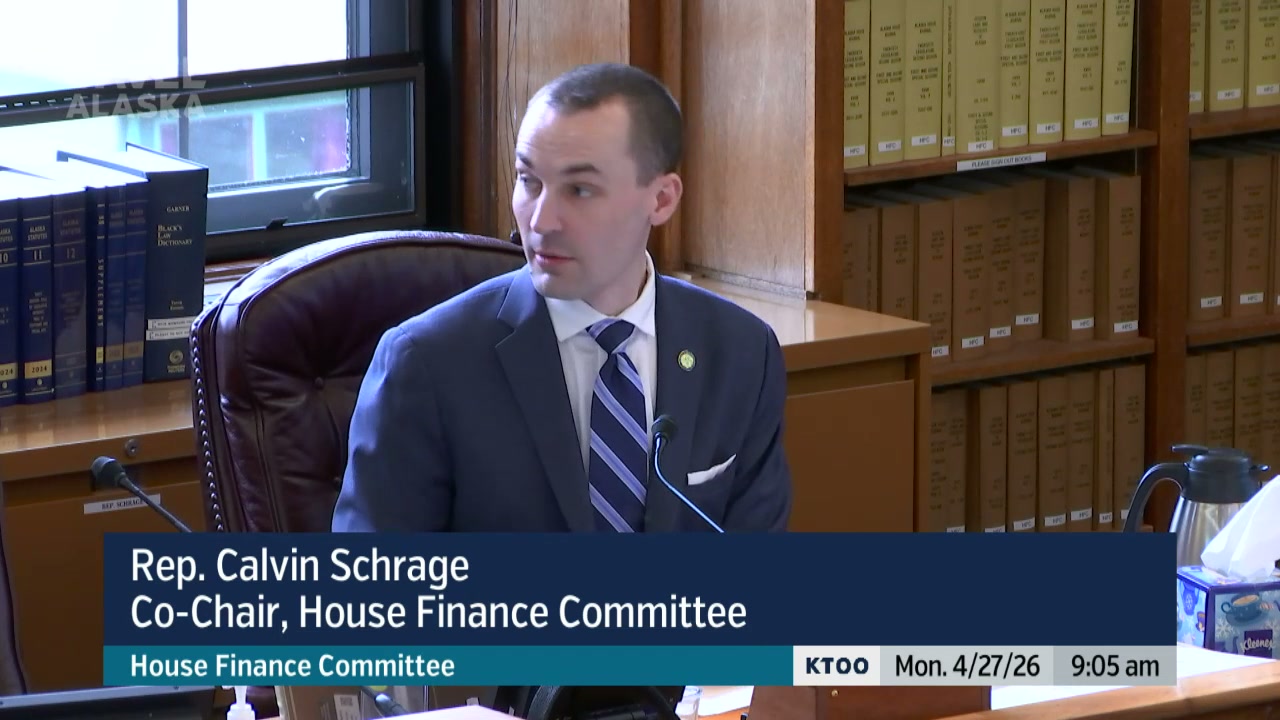
The Alaska House Finance Committee heard presentations April 27 on two batches of budget amendments from Governor Mike Dunleavy's administration. The changes include $8.4 million in unrestricted general fund operating adjustments and capital transportation project allocations.
The amendments, transmitted April 8 and April 23, adjust the fiscal year 2027 budget. The April 8 submission allocated the Statewide Transportation Improvement Program and Airport Improvement Program projects. The April 23 amendments primarily included contractual bargaining unit agreements and other adjustments. The operating changes include salary increases for public safety employees, corrections to transportation funding estimates, and reversals of university pay raises for newly unionized workers.
"The numbers and the total amount that were transmitted are fairly small, so it does not change the outcome of the fiscal summary for the governor's budget too dramatically," said Lacey Sanders, director of the Office of Management and Budget.
Operating budget changes
The operating amendments reduce designated general funds by $8.4 million while increasing unrestricted general funds by the same amount, for a net increase of $2 million across all fund sources.
The Department of Public Safety received unrestricted general funds for contractual salary and health insurance adjustments under the Public Safety Employee Association agreement. An additional $924,000 covers rising dispatch service costs in the Mat-Su and Kenai areas.
"The department did not receive increases to cover those costs, and so therefore we are requesting the ability to fund those costs with an increment," Sanders said.
The Department of Transportation and Public Facilities received funding for salary adjustments for airport police and fire officers under the Public Safety Employee Association agreement.
The Department of Commerce, Community and Economic Development received a $1.3 million fund source change for the newly established Railbelt Transmission Organization. Sanders said the original budget proposed using Railbelt Energy Fund dollars, but those funds proved unavailable after reconciliation with the Division of Finance. The change shifted from one unrestricted general fund source to another.
"This is established as a one-time increment," Sanders said. "Because rates will be set in the future and then we will bring back to the legislature next year those rates to utilize that funding source in a future year."
The University of Alaska saw a budget reversal of salary increases for employees who voted to unionize after the December budget submission. Those workers will now negotiate raises through the collective bargaining process. The December 11 budget had included a 3 percent increase for all non-covered individuals, but Sanders said the employees who voted to unionize were notified before the vote that this step would be taken if they chose union representation.
This article was drafted with AI assistance and reviewed by editors before publishing. Every claim can be verified against the original transcript. If you spot an error, let us know.
Representative Andrew Josephson questioned the change. "Am I right that at least on December 11th, the governor's office took the position that the university could spend its own money to fund say a 3 percent adjustment, and now the university cannot do that even if it wants to?" he asked.
Sanders confirmed the shift. "The individuals that determined or took a vote to unionize will now need to go through the same process that all other unions are required to go through, which is a negotiation process," she said. She added that employees not covered by the union still retain the 3 percent increase in the budget.
Representative Josephson asked whether the affected employees would receive retroactive increases if negotiations conclude after the legislative session. Sanders said the administration treats this like any other union negotiation process and would bring funding requests back to the legislature next year if negotiations extend beyond adjournment. She noted that retroactive agreements are not uncommon in such situations.
Representative Galvin asked whether the administration considered a one-time increment for the newly unionized workers so they would not fall behind colleagues already covered by union contracts during the negotiation period. Sanders said the administration is treating the situation consistently with established union negotiation procedures.
The Department of Administration received a $50,000 federal receipt increase for a court-appointed special advocate and Guardian Ad Litem program support grant from the federal government.
Transportation projects
The capital budget amendments primarily allocated the Statewide Transportation Improvement Program and Airport Improvement Program projects. The April 8 submission reduced the federal match requirement by $324,000 compared to December estimates.
Representative Hannan asked whether the reduction reflected project changes or simply more accurate cost estimates. Sanders said it was the latter. The December budget included high-level estimates, while the April amendments reflected actual project-by-project calculations.
The amendments include federal funds for the Cascade Point ferry terminal project, according to backup documents, though Director of Program Management Dom Pannone initially stated the figure as $49 million while backup documents showed $39.2 million. Sanders said the administration would clarify the discrepancy.
Hannan asked whether the Cascade Point funding addresses permitting delays with the U.S. Army Corps of Engineers. Pannone said the current contract covers upland work and permitting resolution, while the STIP allocation funds in-water construction including dolphins and terminal completion. The state match would be roughly $10 million at the standard 20 percent rate.
The West Susitna Access Road project rose from $84 million to $222 million in the new STIP. Pannone said the increase funds construction of at least one new bridge, though he could not specify which of the project's five planned bridges would be built.
Representative Dan Stapp, who supports the project, asked how many stages remain. Pannone said the STIP includes one parent construction project with two child stages, and the state is approaching the ability to obligate federal funds in fiscal year 2027.
Josephson, who opposes the project, said he sides with hunting and resort opposition to the road. He asked whether the current phase extends beyond the west side of the Susitna River to mining sites behind Mount Susitna. Pannone said he would need to consult the project manager for specifics on mile points and terminus location.
Supplemental requests
The administration submitted $1.75 million in unrestricted general fund supplementals, including two legal settlements. The Department of Law requested $378,000 for Morris O. Johnson Jr. versus the State of Alaska Department of Transportation and Public Facilities, and $1.2 million for Hari versus the Department of Family and Community Services Office of Children's Services.
The Division of Elections received an $819,000 federal Help America Vote Act grant with a $164,000 state match. The operating budget capitalizes the fund, while a companion capital appropriation of $1 million funds election security improvements.
The Alaska Pioneer Homes received authorization to reappropriate $270,000 in leftover roof replacement funds for deferred maintenance at the Palmer facility.
Revenue questions
Much of the committee discussion focused on reconciling budget figures with the state's comprehensive annual financial report, which showed $290 million in available fiscal year 2025 funds.
Sanders said budget accounting and financial accounting use different methodologies. "Budgets and accounting are not the same, and they do not align in the same manner," she said.
She explained that the budget world tracks fund codes precisely to distinguish unrestricted general funds from designated general funds and federal receipts. The accounting world does not make those distinctions.
"If I asked the Department of Revenue, the economic research group, for what was the total amount of revenue collected in a fiscal year and compare that to the total appropriations that were made by the legislature, there is still a deficit," Sanders said.
She cited federal reimbursements as one complication. The state often pays contractors and employees with unrestricted general funds, then receives federal reimbursement later. Those reimbursements deposit into the general fund but do not count as unrestricted general fund revenue in budget terms.
"From a purely technical budget perspective, in looking at total appropriations and total unrestricted general fund, there is still a deficit that would have been borrowed from the Higher Education Investment Fund," Sanders said.
The legislature passed House Bill 289 to return borrowed funds to the Higher Education Investment Fund. Sanders said the transfer did occur and the reversal is proceeding.
Sanders recommended that lawmakers rely on the spring revenue forecast rather than the comprehensive annual financial report when budgeting.
Representative Galvin pressed for a timeline on reconciling the budget and accounting figures. "I heard the figure was at between $230 million and $260 million, that is a high number that I think the public would like to have a better understanding about," she said.
Sanders said she could not provide a quick answer. "It is not something that we are going to solve overnight," she said. "That is why I keep going back to, we know the appropriations, we know the general fund revenue to the state, and if you do the math on those two items, there was a deficit."
Legislative Finance Director Alexi Painter said oil prices have averaged about $10 per barrel above the spring forecast so far. To fund existing appropriations in House Bill 289 and last year's budget, prices need to stay above $80 for the remainder of the fiscal year.
"We kind of have half of that period, right? We have baked in the higher prices and you could go under for the rest," Painter said. She cautioned that short-term price swings make precise projections difficult, particularly for corporate income taxes.
Disaster funding
Representative Will Bynum asked about disaster relief spending and appropriation authority. Sanders said the Office of Management and Budget works closely with the Department of Military and Veterans Affairs to track disaster costs.
House Bill 289 included a $40 million deposit to the Disaster Relief Fund plus contingency language for $37 million to address the Hoonah disaster. Sanders said the state has not received federal approval to change the disaster allocation to a 90/10 split, so she still assumes $35 million in state match will be necessary.
"Right now, in my conversations with Director Brian Fisher, we are in a good place for the match requirement associated with all of the disasters, including Hoonah," Sanders said. The Department of Transportation estimates its disaster costs at $160 million, requiring a 20 percent state match.
The committee took no action on the amendments. Co-Chair Bryce Schrage said the committee's next meeting would be Monday afternoon to hear public testimony on House Bill 261, education funding, and House Bill 271, Kitchen Lights Unit royalty modification.
Stay informed. Support what matters.
Free, permanent access to local news you can verify. Subscribe to support Alaska News and go ad-free.

Comments
Sign in to leave a comment.
No comments yet. Be the first to share your thoughts.