
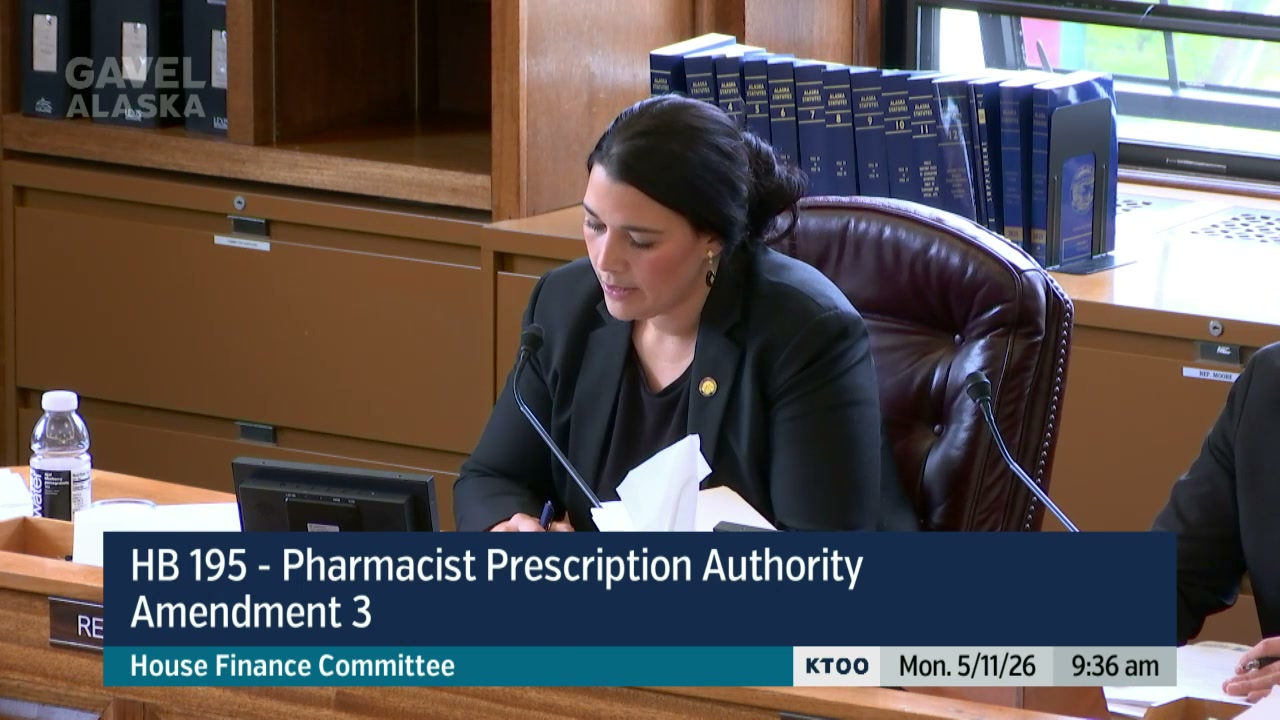
Frame from "HFIN-260511-0900" · Source
House Finance advances pharmacist prescribing bill with drug restrictions
The Alaska House Finance Committee advanced legislation Monday expanding pharmacist prescribing authority while adding restrictions on high-risk medications including opioids and drugs requiring federal certification.
The committee adopted Amendment 3 on a 10-1 vote, prohibiting pharmacists from prescribing or administering drugs that carry federal Risk Evaluation and Mitigation Strategy requirements. Representative Elexie Moore sponsored the amendment. "The intent of this amendment is to make sure pharmacists are not authorized under this bill to prescribe or administer opioids or mifepristone," Moore said. "Amendment Number 3 says that the expanded authority in this bill should not include certain high-risk, specifically restricted drugs."
House Bill 195 aims to clarify what "other patient services" pharmacists can provide under a 2022 law that allowed them to practice at the top of their training.
The committee also approved Amendment 4, which requires physicians and advanced practice registered nurses prescribing opioids for more than three days to also provide a prescription for naloxone, an overdose reversal drug. The amendment passed without objection after initial concerns about insurance coverage were addressed.
Representative Frank Tomaszewski sponsored the amendment. "Any pharmacists that I have actually talked to about this say it's a great idea," Tomaszewski said. "It really is a good opportunity for doctors to educate their patients when they're giving them a prescription."
The naloxone requirement applies to physicians and advanced practice registered nurses, not pharmacists.
Representative Genevieve Mena, the bill's sponsor, supported Amendment 3. "The heart of the bill is really about expanding basic primary care access," Mena said. "We don't want pharmacists to be doing prescriptions for a lot of different specialty drugs, particularly these high-risk drugs that the FDA designates as being risky to a patient or an individual."
The committee rejected Amendment 5 on a 2-9 vote. That amendment would have explicitly prohibited pharmacists from dispensing what the amendment text called "abortion-inducing drugs" and "selective progesterone receptor modulators."
Moore and Mena said Amendment 3 already addressed the issue by restricting drugs with federal REMS requirements, which include mifepristone. Moore noted that the drugs covered by Amendment 5 have multiple medical uses beyond abortion.
"One of the complications with using the word dispense in statute language is that these drugs in this amendment aren't exclusively for elective abortions," Moore said. "They are also for managing miscarriages after fetal death, nonviable pregnancies, cervical prep before medical procedures, treatment of Cushing syndrome, managing endometriosis and other uterine lining issues."
This article was drafted with AI assistance and reviewed by editors before publishing. Every claim can be verified against the original transcript. If you spot an error, let us know.
Comments
Sign in to leave a comment.
No comments yet. Be the first to share your thoughts.