AI-powered community news covering local government, public meetings, and community issues across Alaska.
Alaska
House Extends West Coast Disaster Declaration After Heated Debate | Alaska News | Alaska News
House Extends West Coast Disaster Declaration After Heated Debate
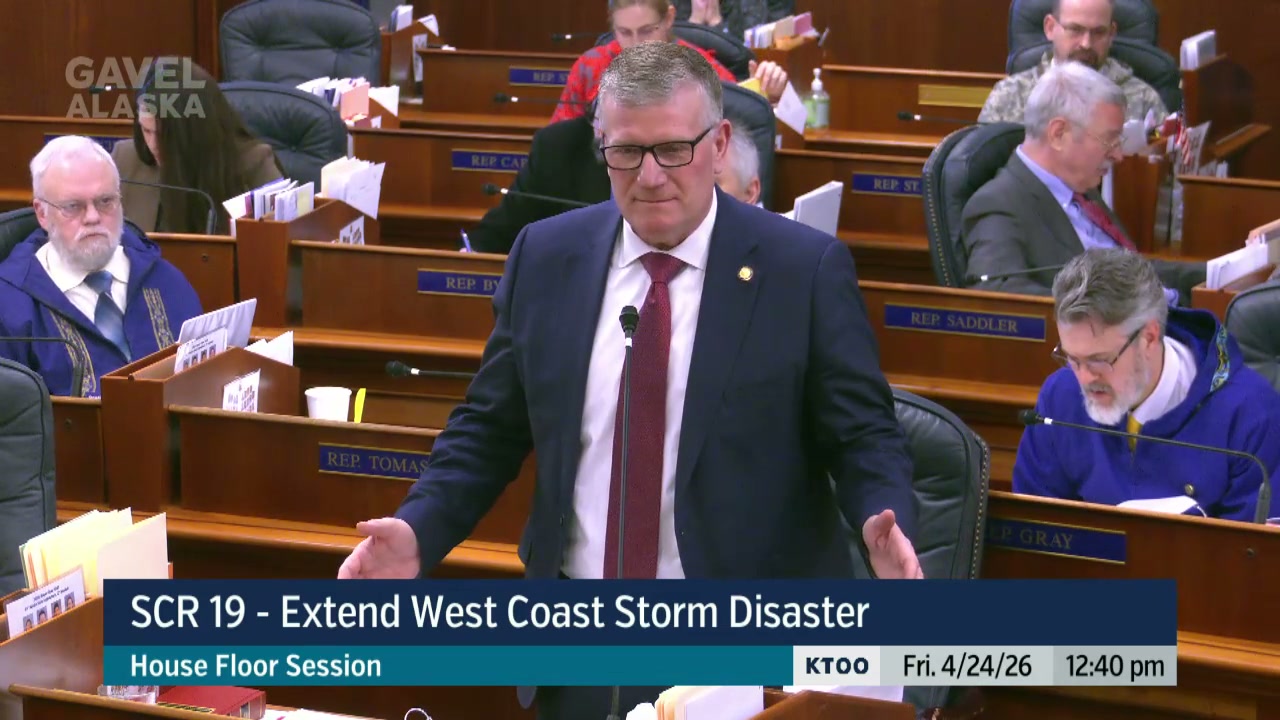
Frame from "House Floor Session, 4/24/26, 10:30am" · Source
PublishedAI
House Extends West Coast Disaster Declaration After Heated Debate
by Alaska NewsApr 25, 2026(1w ago)6 min readJuneau
Share
The Alaska House of Representatives voted Friday to extend the West Coast storm disaster declaration for another 30 days. The vote followed a floor debate over whether the legislature should use a concurrent resolution or pass a bill to authorize the spending.
The House approved Senate Concurrent Resolution 19 by a vote of 28-11. The resolution extends the disaster declaration retroactive from April 7 to May 7. Before final passage, the House adopted an amendment by a 28-11 vote that attached a revised financing plan to the resolution. The amended plan totals $63.83 million, including $25.13 million in federal authority and $37.7 million in state funds. That represents an increase of $23.58 million over the previously approved plan.
The amendment lays out what has been spent, what has come in from the federal government, and what needs remain, according to the assembly member who sponsored the measure.
"Essentially, it is quite readable, but what it does is it says it lays out sort of where we are, what has been spent, what has come in from the federal government, what needs there are now, and it notes importantly that there is no appropriation necessary," the sponsor said.
The disaster declaration stems from a storm that hit Alaska's west coast. The governor originally issued the declaration on October 9. Under state law, disaster authority is only valid for 30 days and must be extended either by calling a special session or through action by the presiding officers when the legislature is not in session. Once the legislature convened in January, further extensions required action by the full body.
The House has now passed three such extensions this session. The previous two were Senate Concurrent Resolution 12 in February and House Concurrent Resolution 11 in March. Friday's vote came 17 days after the previous declaration expired on April 7.
Debate Over Process
The debate exposed a divide over process. Several Republican members argued the legislature should pass a bill rather than a resolution, citing concerns about transparency, oversight, and whether the resolution approach satisfies state law.
One House member said the legislature has a responsibility to ensure disaster funds are spent properly with transparency, especially when the disaster declaration allows no-bid contracts and waives certain permits. "We are not taking our oversight responsibilities seriously," the member said.
Another member cited a legal memo from Legislative Legal Services stating that approval of an amended financing plan by concurrent resolution would not satisfy Alaska Statute 26.23.025(b), which contemplates that the legislature will ratify the governor's actions by law. The member said the total cost of the recovery effort could reach $150 million, but the current financing plan does not request that full amount.
This article was drafted with AI assistance and reviewed by editors before publishing. Every claim can be verified against the original transcript. If you spot an error, let us know.
"I think that we can do better and should do better," the member said. "And I feel like I am repeating myself from the last two times we have debated this, but we have not done it yet, and I have doubts that we will."
Another member said the disaster has moved beyond the immediate emergency phase into a rebuilding phase that requires a different approach. "We need to start a plan for rebuilding," the member said.
Supporters of the resolution defended the process as following state law and providing the necessary flexibility to respond to emergencies. One member noted that the statute on extending a disaster declaration specifically says to use a concurrent resolution.
Another member said the resolution brings an extension of a declaration of disaster emergency funding before the entire body as a committee of the whole, preventing a single committee chair from holding up emergency relief. "The reason why emergency measures come before the Committee of the Whole is because it is transparent, it is emergency, and we are following the law," the member said.
The sponsor of the resolution said the legislature is not appropriating new money with the resolution, only authorizing the expenditure of funds already appropriated. "We are not appropriating new money, it is the old money. We are just turning the key, that is all," the sponsor said.
The sponsor also noted that two distinguished former speakers, when given a chance to refresh the law in 1999, declined to change the resolution process. "They wanted the dexterity, the ability to pivot, and they thought that by resolution was the appropriate process," the sponsor said.
The sponsor compared the disaster's scope to the Great Alaska Earthquake. "I think this disaster rivals the Great Alaska Earthquake. That is what I think is going on," the sponsor said. "So when the question is, what is the time frame? The administration does not know."
The sponsor also noted that earlier in the year, the administration had asked the presiding officers for an additional letter extending the declaration, but the officers declined, saying that once the legislature was in session, a resolution was required.
Legal Compliance Concerns
Several members raised concerns about whether the resolution process satisfies legal requirements. Members cited legal memos from Legislative Legal Services questioning whether concurrent resolutions adequately fulfill the statutory requirement that the legislature ratify the governor's actions by law.
One member noted that Alaska Statute 26.23.025(b) requires legislative ratification by law, and that failure to do so could render the governor's actions void. "If we leave here and did not ratify this by law," the member said, expressing concern about potential legal challenges.
Members also questioned whether the financing plan meets all statutory requirements, particularly the requirement to include an estimated timeframe necessary to cope with the disaster. The sponsor responded that the timeframe is currently unknowable given the unprecedented scope of the disaster.
One member noted that the disaster declaration had already expired on April 7 and that the House was passing the extension 17 days late. "We had the opportunity to fix this. We just chose not to," the member said.
Audit Concerns
One member raised concerns about findings in the State of Alaska single audit for the fiscal year ended June 30, 2025. The member said a review of disaster grant payments found that 15 payments, 88 percent, lacked adequate supporting documentation.
"There is no way that I will be able to vote for this amendment until we have other documentation from the Department of Military and Veterans Affairs that they are actually doing the right thing," the member said.
Another member responded that single audits come out every year and that standing committees should address issues raised in them, but that failing to pass disaster resolutions because of ongoing audit work would endanger addressing every future disaster.
Ongoing Response
Many Alaskans remain displaced from their communities, and ongoing emergency actions are still required in affected communities. The declaration allows state agencies to continue their emergency response and to expend state funds as needed.
The resolution does not address what percentage the federal government will ultimately pay for disaster costs. The House added a large amount to the disaster relief fund in the supplemental budget. According to floor debate, the Senate is adding another $10 million for fiscal year 2027 in its operating budget.
The next extension, if needed, would come before the legislature adjourns. Once out of session, the statute allows the presiding officers to move forward unilaterally with 30-day extensions.
Stay informed. Support what matters.
Free, permanent access to local news you can verify. Subscribe to support Alaska News and go ad-free.

Comments
Sign in to leave a comment.
No comments yet. Be the first to share your thoughts.