
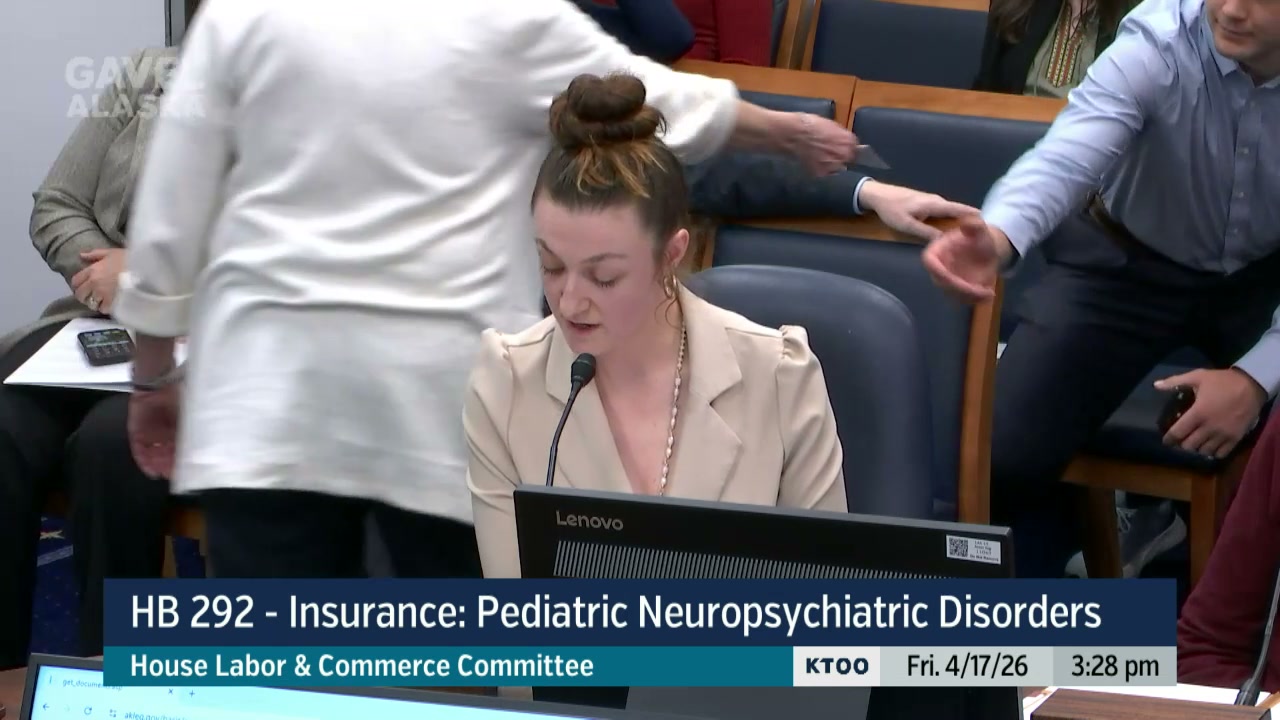
Frame from "House Labor & Commerce, 4/17/26, 3:15pm" · Source
House committee advances insurance coverage for PANDAS/PANS treatment
The Alaska House Labor and Commerce Committee heard emotional testimony Friday on legislation that would require insurance companies to cover treatments for children suffering from devastating neuropsychiatric disorders triggered by infections.
House Bill 292 addresses coverage for PANDAS and PANS, pediatric autoimmune neuropsychiatric disorders that cause sudden, severe behavioral changes in children. The bill would mandate insurance coverage for treatments including intravenous immunoglobulin therapy, which currently costs families tens of thousands of dollars out-of-pocket when insurers deny claims.
The legislation moved out of the Labor and Commerce Committee on April 17, 2026, with all six members voting "Do Pass." It now heads to the House Finance Committee. The bill previously cleared the House Health and Social Services Committee on March 17, with three members voting "Do Pass" and two offering "No Recommendation."
Representative Julie Coulombe introduced the bill after hearing from constituent Rebecca Pullins about her son Finn. Coulombe said the legislation puts kids first and ensures parents can get the treatments their children need.
"She talked me through her family's journey with PANDAS and PANS, which are neuropsychiatric disorders," Coulombe said. "And their fight with insurance companies who deny medically necessary care."
Pullins testified that her seven-year-old son changed overnight after a strep infection. He developed obsessive-compulsive disorder, uncontrollable body movements, and fits of rage. Getting dressed took 45 minutes. He could not eat or play with his sister.
"We thought we had lost our son," Pullins said. "Our daughter had lost her playmate and best friend. We were terrified we would never get him back."
The disorders occur when a strep infection or other trigger causes a child's immune system to attack the brain instead of the infection. Symptoms can include sudden onset of OCD, anxiety, rage, inability to function, and physical tics. Without quick diagnosis and treatment, children may need expensive interventions.
One mother testified that her 14-year-old son was taken to McLaughlin Youth Center in Anchorage in 2025 after a terrifying escalation of behaviors. Juvenile detention was the only option available after repeated denials from psychiatric and medical facilities.
"My son was not a criminal," she said. "He was a child experiencing severe brain inflammation, but no one knew that yet."
It took more than a decade to find treatment. When her son was released from detention, she started him on maximum-dose ibuprofen. Within 72 hours, the violent aggression was gone. Comprehensive labs showed almost everything was abnormal: inflammatory markers, autoimmune indicators, infectious titers, hormone disruption.
This article was drafted with AI assistance and reviewed by editors before publishing. Every claim can be verified against the original transcript. If you spot an error, let us know.
Related Coverage
House panel fast-tracks insurance coverage for PANDAS treatment
Alaska News · 5d ago · 2 views · 96% match
House Finance Advances Mental Health Education Guidelines for Schools
Alaska News · 5d ago · 1 views · 80% match
House passes bill requiring transparency at psychiatric hospitals for minors
Alaska News · 8h ago · 2 views · 79% match
House Labor Committee Advances Travel Insurance Bill, Hears Disaster Pet Plan
Alaska News · 4d ago · 1 views · 79% match
House panel advances travel insurance consumer protection bill
Alaska News · 2d ago · 2 views · 79% match
Comments
Sign in to leave a comment.
No comments yet. Be the first to share your thoughts.