
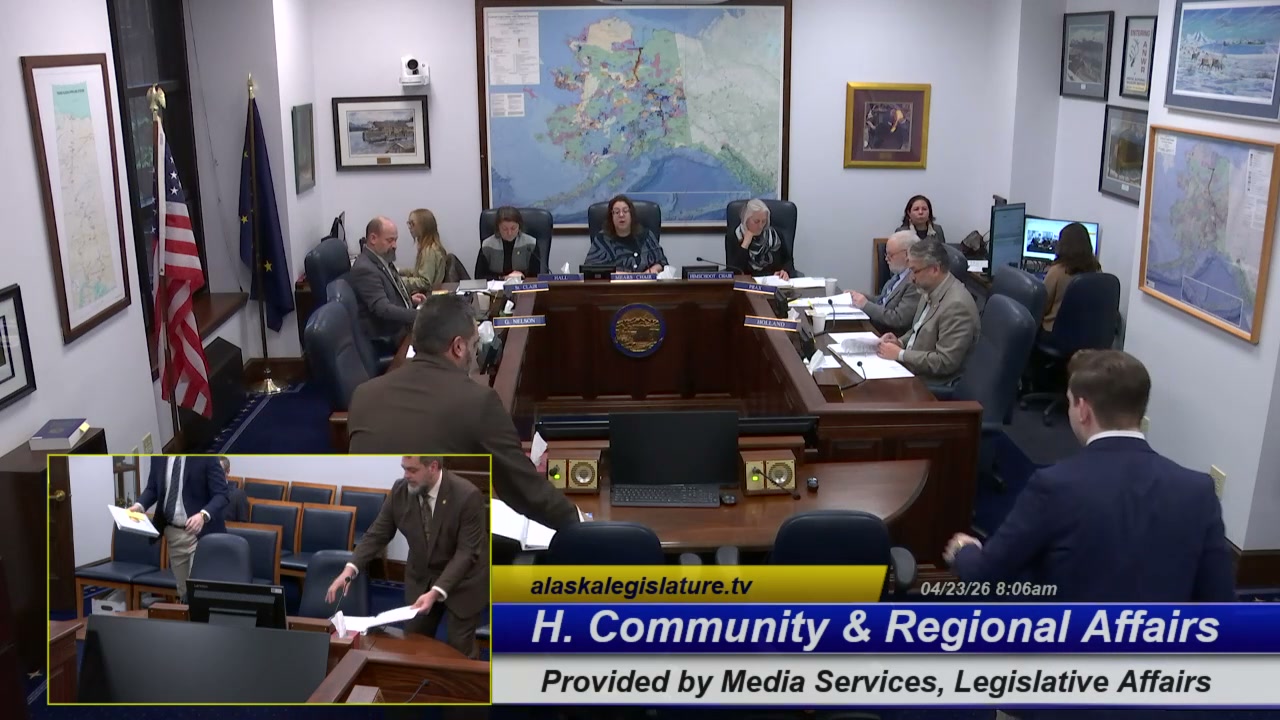
Frame from "HCRA-260423-0800" · Source
House committee advances bill adding unorganized borough seat to boundary panel
The House Community and Regional Affairs Committee voted Thursday to advance legislation that would add a seat to the Alaska Local Boundary Commission for a resident of the unorganized borough.
Senate Bill 63 would expand the five-member commission to six members and require that at least one commissioner live in and be registered to vote in the unorganized borough. The unorganized borough includes 74,448 residents, representing 10 percent of Alaska's population, according to Sandra Moller, director of the Division of Community and Regional Affairs.
The commission acts on petitions for incorporation, dissolution, merger, and consolidation of cities and boroughs. Currently, one commissioner is appointed from each of Alaska's four judicial districts, plus one state-appointed member.
Senator Mike Cronk, who sponsored the bill, noted the Alaska Constitution divides the state into organized and unorganized boroughs without requiring all areas to organize. He pointed out many unorganized areas cannot afford the administrative costs of incorporation.
"There's just a lot of places in Alaska that organized, whether it's a city or municipality or borough, doesn't make any sense," Cronk said. "It's really a burden upon the people there if you're going to create a system that is unaffordable."
Cronk said residents of unorganized areas are not asking for services beyond what the state is required to provide. "A lot of our unorganized areas aren't asking for much more than the state's required to provide, right? We're not asking for, you know, swimming pools and all that stuff. We're just out there living," he said.
During discussion, Cronk provided context about the Trans-Alaska Pipeline, noting that a significant portion runs through unorganized areas. He explained that if these areas were forced into boroughs, tax revenue from the pipeline that currently goes to the state would instead go to those boroughs, potentially costing the state money. Committee Co-Chair Donna Mears added that a little north of 40 percent of the gas pipeline mileage is in unincorporated areas.
The bill also extends commissioner terms from five years to six years so that one seat comes up for appointment each year. The bill establishes in statute that commissioners appointed from the unorganized borough and their respective judicial districts must actually live in and be registered to vote in the districts from which they are appointed. The bill also allows the commission to select its own chair. The changes would take effect January 31, 2027, and would not affect current commissioners' terms.
Committee Co-Chair Rebecca Himschoot said she supports ensuring the commission's decisions are informed by voices from all areas that could be affected. "The function of the commission is to act on petitions for incorporation, dissolution, merger, and consolidation of cities and boroughs," Himschoot said. "I think I am in support of trying to make sure that the decisions made by that commission are informed by voices from all the areas that could or would be impacted."
This article was drafted with AI assistance and reviewed by editors before publishing. Every claim can be verified against the original transcript. If you spot an error, let us know.
Comments
Sign in to leave a comment.
No comments yet. Be the first to share your thoughts.