
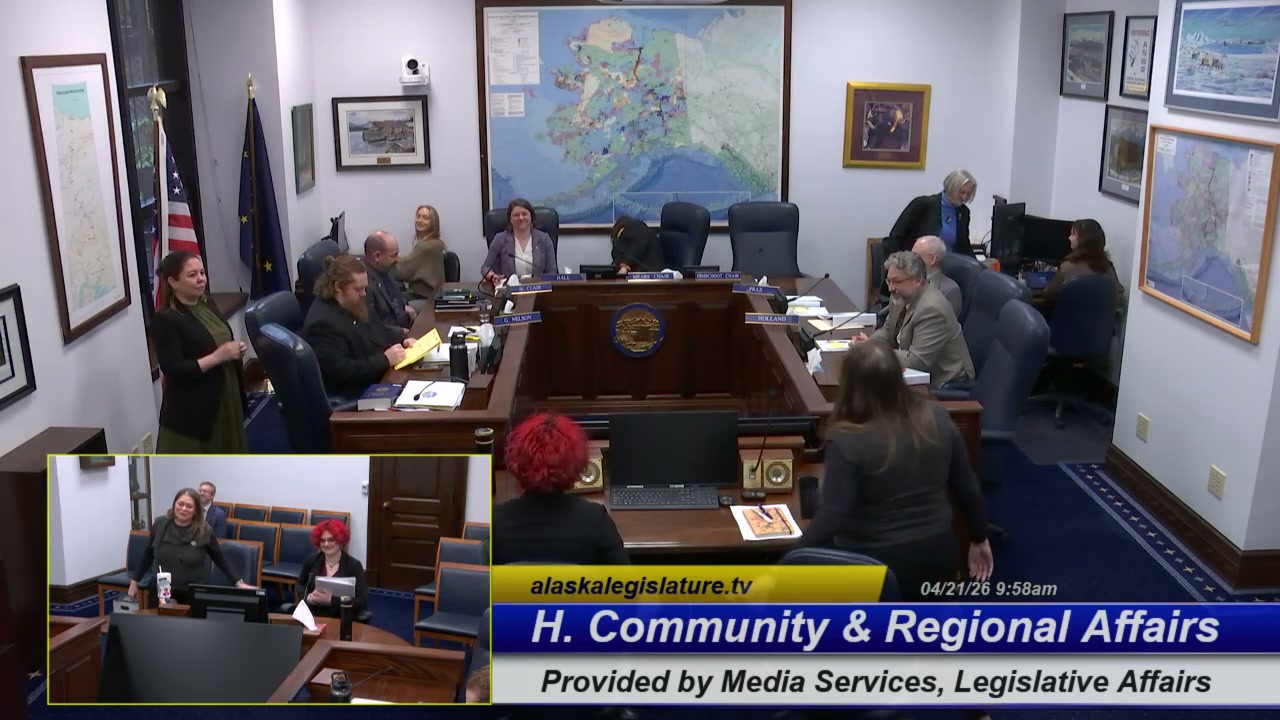
Frame from "House Community & Regional Affairs, 4/21/26, 8am" · Source
Alaska's Right-to-Repair Bill Navigates National Debate on Consumer Access
Alaska lawmakers advanced a right-to-repair bill Tuesday that would require manufacturers to provide repair documentation, parts, and tools to independent shops and consumers. The move positions the state within a national debate over how far such mandates should reach.
The House Community and Regional Affairs Committee voted 4-3 to move House Bill 162 forward after adopting five of ten proposed amendments during an extended hearing. The bill, sponsored by Representative Maxine Dibert of Fairbanks, would apply to digital products sold or used in Alaska, from smartphones to power sports vehicles.
The committee's work reflects tensions playing out across the country as states consider repair legislation. More than 30 states have introduced right-to-repair bills since 2021, according to repair advocacy groups, though approaches vary widely.
"House Bill 162 ensures that Alaskans and independent repair providers have access to the same documentation, parts, and tools that manufacturers already provide to their authorized service providers," Dibert said. "This bill is about access, fairness, and making sure our markets are working the way they should."
The committee adopted Amendment 1, which clarified that if a contract provision violates the statute, only that provision would be voided rather than the entire agreement. The amendment passed without objection.
The committee also adopted Amendment 2, which exempts critical infrastructure, systems and assets vital to state security, economic security, or public health. Representative Garrett Nelson, who proposed the amendment, cited security risks if repair information for infrastructure like power systems or water treatment facilities became widely available. The amendment passed 5-2.
But the committee rejected Amendment 3, which would have narrowed the bill to consumer electronics and household appliances. That amendment failed 3-4. Opponents said it would exclude Alaskans who rely on equipment like ATVs, snow machines, and tractors for daily transportation and subsistence.
"In many states, limited repair access is an inconvenience," Dibert said. "In Alaska, it is a real barrier. Because of our geography, authorized repair providers are often hundreds or even thousands of miles away."
Emma Solchinski, intern to Representative Dibert, noted that European Union right-to-repair regulations cover a broader range of products than most U.S. state laws, though the EU represents a much larger market.
The committee also adopted Amendment 7, addressing parts pairing, the practice of digitally linking components so they only work together. The bill as amended would prohibit manufacturers from using parts pairing to prevent repairs, though manufacturers could still use it for legitimate configuration purposes. That provision drew debate. Representative Kai Holland noted that proprietary replacement parts are a fundamental business model protected by intellectual property law.
This article was drafted with AI assistance and reviewed by editors before publishing. Every claim can be verified against the original transcript. If you spot an error, let us know.
Comments
Sign in to leave a comment.
No comments yet. Be the first to share your thoughts.