
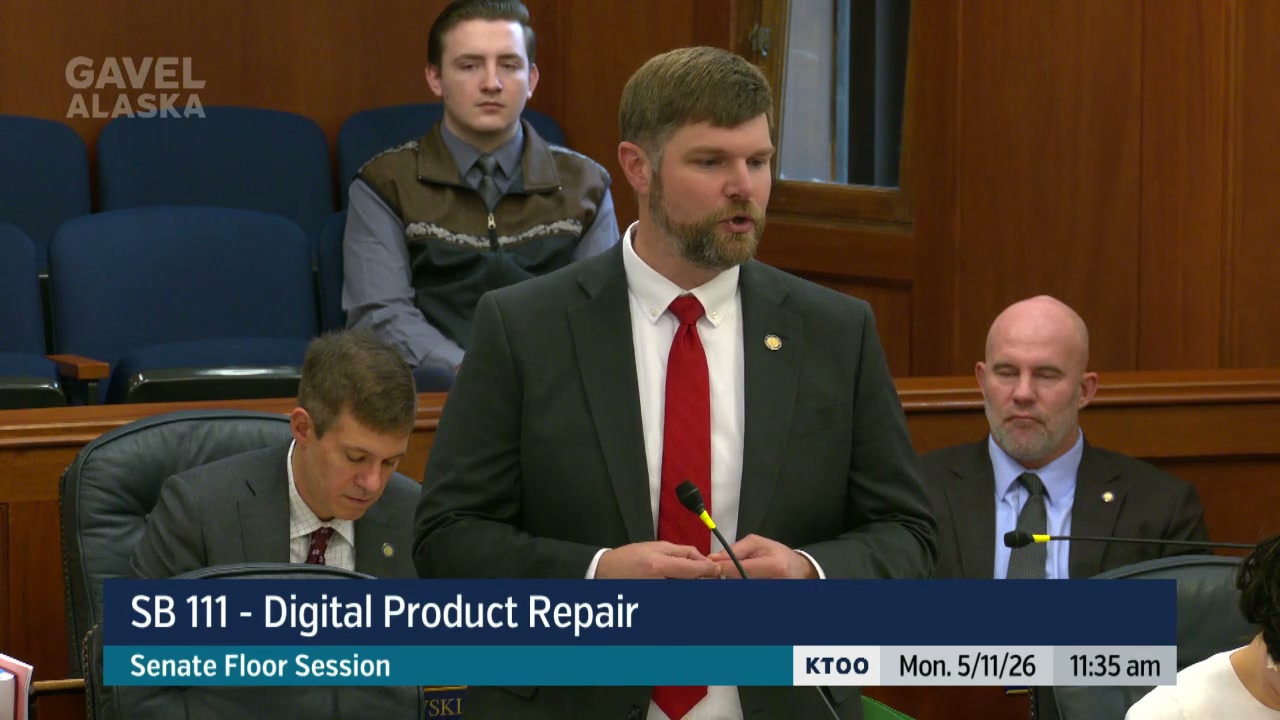
Frame from "SFLR-20260511-1100" · Source
Alaska Senate Passes Right-to-Repair Bill for Consumer Electronics
The Alaska Senate voted Monday to require manufacturers to provide repair access for consumer electronics, advancing legislation that supporters say will keep money in Alaska and reduce electronic waste.
Senate Bill 111 passed 15-5 after debate over digital locks and security exemptions. The bill requires manufacturers to provide parts, tools, and repair information to consumers and independent repair shops for consumer electronics like phones and personal computers.
Alaska News previously reported that the Senate Labor and Commerce Committee narrowed the bill's scope to consumer electronics after concerns from powersports dealers. The committee removed snowmachines, watercraft, and other heavy equipment from the legislation. The bill joins similar efforts in more than a dozen states including Arizona, Illinois, Hawaii, Colorado, Indiana, Missouri, Maine, Michigan, New Jersey, Oklahoma, Ohio, Pennsylvania, Rhode Island, and Washington during the legislative session.
The Senate adopted one amendment exempting fire alarms, life safety systems, intrusion detection systems, and physical access control equipment from the bill's requirements. Senator Mike Cronk, who sponsored the amendment, said those systems are specifically designed around security, restricted access, and system integrity.
Senator Forrest Dunbar, the bill's sponsor, supported that narrow exemption but opposed a broader amendment that would have removed language prohibiting manufacturers from using digital locks to prevent repairs. The second amendment failed eight to 12.
Dunbar said broad security exemptions have been used in other states to undermine repair protections. In Oregon, a similar exemption was used to exempt electronic toothbrushes, he said. The Federal Trade Commission has found scant evidence that the ability to maintain and repair products makes them less secure, according to Dunbar.
During debate on the first amendment, Dunbar sought to clarify the legislative record that the exemption was intended to be narrow and not sweep in ordinary household devices. "The bill already exempts the large business-to-business and industrial security systems. This is only for consumer electronics, this bill. And so what this would potentially do is exempt even the smallest little fire alarm that you might put in your own house. I want to make sure that's not the intent here," Dunbar said. Cronk confirmed that was not the intent.
Dunbar framed the bill as protecting a basic principle. "When you buy something, you should own it and have the right to repair it," he said. "This bill is unfortunately necessary because this idea, this principle, which was once accepted as common sense, has been increasingly violated by certain out-of-state consumer technology and manufacturing companies."
This article was drafted with AI assistance and reviewed by editors before publishing. Every claim can be verified against the original transcript. If you spot an error, let us know.
Comments
Sign in to leave a comment.
No comments yet. Be the first to share your thoughts.