AI-powered community news covering local government, public meetings, and community issues across Alaska.
Alaska
Alaska LNG Tax Bill Stalls as Lawmakers Demand Project Cost Data | Alaska News
Alaska LNG Tax Bill Stalls as Lawmakers Demand Project Cost Data
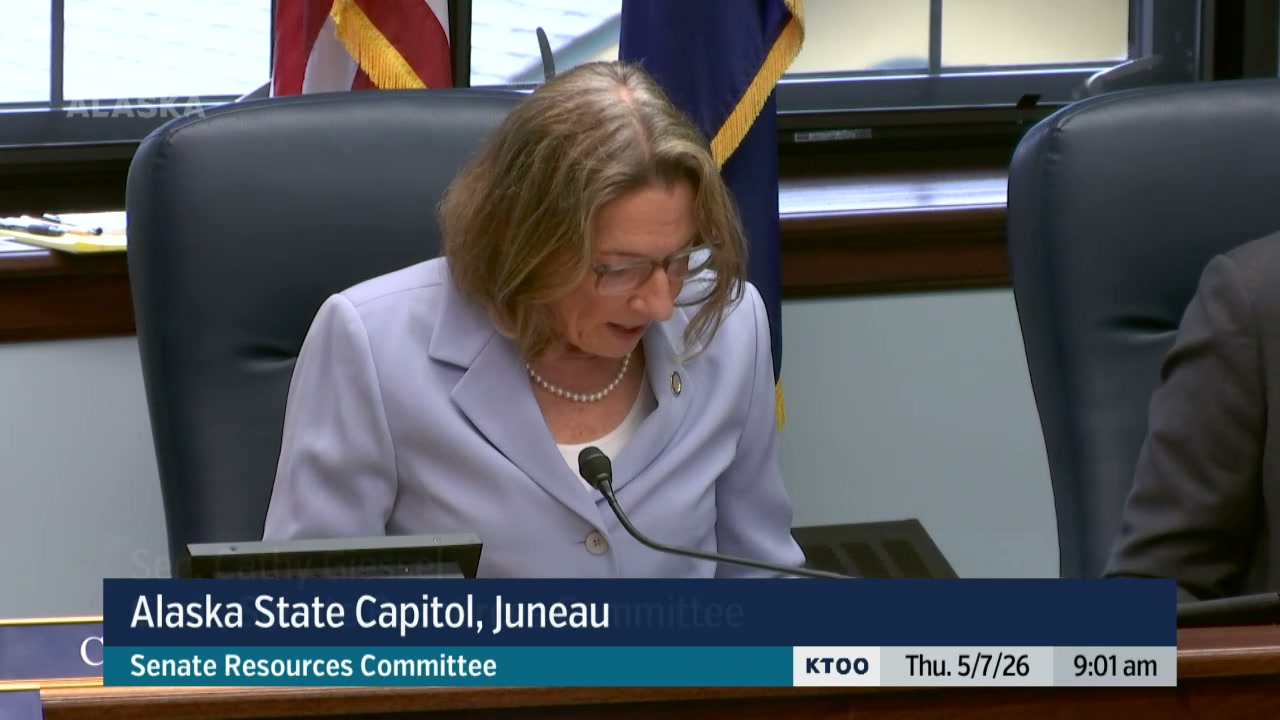
Frame from "Senate Resources, 5/7/26, 9am" · Source
PublishedAI
Alaska LNG Tax Bill Stalls as Lawmakers Demand Project Cost Data
by Alaska NewsMay 8, 2026(8h ago)5 min readJuneau, Alaska
Share
The Alaska State Senate Resources Committee heard Thursday that lawmakers lack the information needed to set tax policy for the proposed Alaska LNG project, even as the legislative session enters its final days.
Nick Fulford, a consultant hired by the committee, told senators they need access to confidential project cost data and gas pricing arrangements to enable informed discussion of fiscal terms. Fulford is senior director for gas, LNG and energy transition at Gaffney Klein. The committee is considering Senate Bill 280, which would replace the current property tax structure with a volumetric tax on the liquefied natural gas project.
The Alaska LNG project would transport gas from North Slope fields through an pipeline to a liquefaction facility. Alaska News previously reported that the Alaska Gasline Development Corporation released a $38.7 billion cost estimate in June 2025, down 12.4 percent from a 2015 estimate. Governor Mike Dunleavy has proposed a six-cent per thousand cubic feet tax to make the project financeable, while the House Resources Committee drafted a bill with a 20-cent rate aimed at preserving municipal revenue share. The current Senate version proposes 55 cents per thousand cubic feet. Tax-relief proposals are conditional on construction of a spur pipeline to Fairbanks.
Missing Data Creates Constitutional Dilemma
"Under the current committee substitute, I would say that is a relatively high tax and one which may not be supportable by the project," Fulford said. "I think the numbers suggest that."
Fulford explained that the current Alaska LNG project differs fundamentally from the earlier SB 138 project because three key commercial negotiations remain unresolved: gas supply contracts between North Slope producers and the midstream project, LNG sales agreements, and equity investment arrangements. Project economics data is sensitive to all three negotiations.
"The requirement really for the legislature to have some appropriate degree of insight and transparency into the project to enable an objective discussion around fiscal terms," Fulford said. He added that good practice and the legislature's constitutional obligations require understanding the broad economic framework around a project being taxed.
Senator Scott Kawasaki expressed frustration with the timing. "We are in day 108, 109 of a 120-day session," Kawasaki said. "So we as resources are sort of, I mean, I will speak for myself, a little stressed that I do not have this information yet, but I am supposed to make these multibillion-dollar decisions with a 30-year horizon, time horizon, within the next week."
Upstream Gas Price Holds More Power Than Tax Cuts
Fulford's analysis showed that the price North Slope producers charge for gas to the midstream project has a larger impact on project viability than the proposed tax changes. At current oil prices, the project would be competitive with a $1 per thousand cubic feet upstream gas price and the proposed 55-cent volumetric tax. But if producers charge $1.50 per thousand cubic feet, the figure the Department of Revenue has used in modeling, Senator Forrest Dunbar said his reading of Fulford's analysis suggested the project would not break even even with the governor's proposed six-cent tax.
This article was drafted with AI assistance and reviewed by editors before publishing. Every claim can be verified against the original transcript. If you spot an error, let us know.
"The current AVT is 55 cents per MCF. The difference between $1 and $1.50 in the upstream price is roughly the same," Fulford said.
Dunbar drew out the implications. "Even if we pass a 90 percent tax cut, the state of Alaska has less ability to impact this project than the gas producers, the major oil and gas producers on the North Slope," Dunbar said. "They can, through changing the upstream price, basically determine whether this project goes or does not go."
Senator Bill Wielechowski said the Department of Revenue had reported that North Slope gas producers could earn an 83 percent internal rate of return on gas sales to the LNG project.
Clean Team Approach Proposed
Fulford recommended Alaska adopt a "clean team" approach used in other jurisdictions, where a small group of state officials with subject matter expertise reviews confidential project data under nondisclosure agreements and reports findings to the legislature without revealing commercially sensitive details.
"The word clean team you will hear sometimes referred to as this group that broker the information," Fulford said. He cited examples from the International Monetary Fund's Fiscal Analysis of Resource Industries framework, used in Senegal and Mozambique LNG projects.
Fulford said the Department of Revenue's existing model could be an excellent starting point if given appropriate inputs and presented appropriately to the legislature. He noted that detailed dialogue with DOR on the model began only about a week to 10 days earlier.
Wielechowski questioned the dynamic between the administration and the project developer. "It is such an odd and uncomfortable position that I feel we are in, where it feels like the governor is almost doing the bidding of Glenfarm," Wielechowski said, referring to the private equity firm leading the project.
Wielechowski pressed Fulford on protecting state interests in upstream gas pricing, expressing concern that producers could value gas at a low price on the North Slope to reduce royalties and production taxes, then capture value elsewhere in the chain.
Project Competitiveness Depends on Multiple Variables
Fulford's analysis showed Alaska LNG would be competitive with U.S. Gulf Coast exports to Asia if upstream gas costs remain at $1 per thousand cubic feet and capital costs do not exceed the base case estimate. Under the current 55-cent volumetric tax proposal, the project loses its competitive edge if gas costs rise above $1.65 or capital costs exceed the base case by more than 16.5 percent. Under the governor's six-cent proposal, those thresholds increase to $2.17 for gas costs and 31 percent for capital overruns.
"Alaska would be competitive and profitable at a 12.5 percent oil indexation at around a $65 or $70 oil price," Fulford said, referring to the conventional pricing mechanism for Asian LNG contracts.
Fulford noted that recent LNG contracts have averaged 12.4 percent oil indexation, and that forward prices for Henry Hub natural gas, the benchmark for U.S. Gulf Coast LNG, could reach $4 to $5 per million BTU by 2030, making Alaska more competitive.
Momentum Versus Missing Milestones
Kawasaki noted that the project has missed key deadlines, including a December 2025 target for a final investment decision on the pipeline portion. "This project that we are talking about today, it is probably the biggest, most complex gas infrastructure project in the entire world," Fulford said, adding that slippage on major decision points is not surprising given the scale.
Fulford suggested that even if the committee cannot finalize tax policy this session, progress on an alternative tax framework would be well received by the market. "Even if we cannot get to a final solution today, progress on the project in the form of an alternative tax framework, for example, I think would be well received by the market and by other interested parties," Fulford said.
The committee did not take action on the bill Thursday.
Stay informed. Support what matters.
Free, permanent access to local news you can verify. Subscribe to support Alaska News and go ad-free.

Comments
Sign in to leave a comment.
No comments yet. Be the first to share your thoughts.