
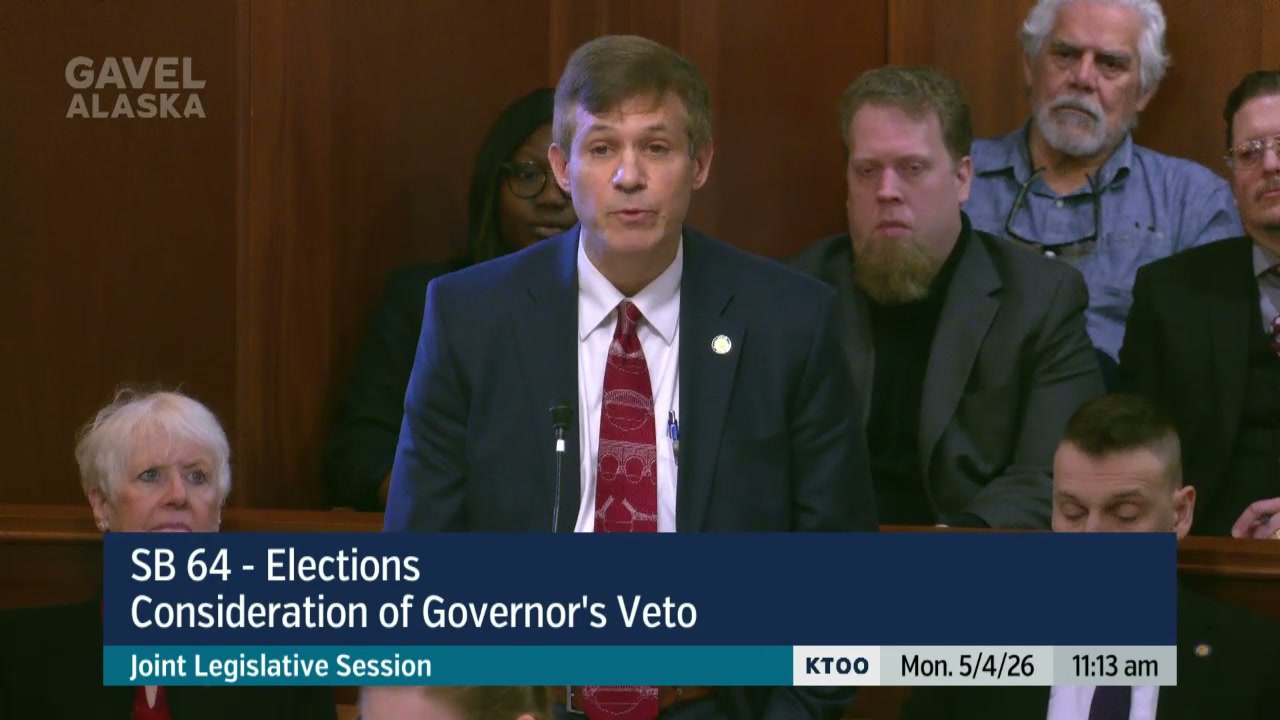
Frame from "MISC-20260504-1030" · Source
Alaska Legislature Falls Two Votes Short of Overriding Elections Bill Veto
The Alaska Legislature fell two votes short Monday of overriding Gov. Mike Dunleavy's veto of a comprehensive elections reform bill that would have let voters track their ballots online and fix minor errors before their ballots are rejected.
Senate Bill 64 would have allowed voters to track their ballots online, given them a chance to fix minor errors on ballot envelopes, clarified that tribal identification is acceptable at polling places, and created a rural liaison position to help remote communities conduct elections.
Senate President Gary Stevens announced the result after a two-hour debate. "By a vote of 38 yeas and 22 nays, the joint legislative session has failed to override the governor's veto of Senate Bill 64," Stevens said.
The bill represented nearly a decade of work on election reform. Over the past 10 years, legislators introduced 164 election-related bills and more than 40 resolutions, but only three became law and none significantly changed how Alaska conducts elections, according to Sen. Bill Wielechowski, who helped negotiate the compromise. Rep. Sarah Vance noted she had scrutinized the vast majority of those bills during her eight years in the legislature.
Wielechowski said the bill emerged from months of negotiations between legislators who disagree on ranked choice voting but agreed on election administration improvements. He said the governor's veto message cited "operational burdens" rather than policy disagreements, despite the administration supporting similar provisions in legislation it introduced in 2022.
Dunleavy vetoed the bill in late April, saying the Division of Elections needed more time to implement the changes. His administration had introduced ballot tracking and curing legislation in 2022 with a July 1 effective date, requiring implementation in less than two months. Senate Bill 64 would have delayed implementation until the November general election, 182 days away.
Vance, a Homer Republican who co-sponsored the bill, said the current system fails voters. "Right now, our system is broken where not every vote is being counted," Vance said. "My constituents tell me that every illegal vote cancels out their legal one, thus nullifying their voice."
Sen. Loki Tobin said approximately 1.7 percent of Alaska voters had their ballots rejected in the 2024 general election. In his district, which includes Joint Base Elmendorf-Richardson, 123 ballots were rejected, with 53 thrown out because of witness signature issues. "Just imagine being a soldier, an airman stationed overseas defending democracy and not having your voice heard here in Alaska," Tobin said.
Ballot curing exists in 33 states, and ballot tracking is used in 46 states, according to the U.S. Election Assistance Commission's 2024 report to Congress. Sen. Mike Cronk noted that Texas and Florida, two Republican-led states, have both ballot tracking and ballot curing.
This article was drafted with AI assistance and reviewed by editors before publishing. Every claim can be verified against the original transcript. If you spot an error, let us know.
Comments
Sign in to leave a comment.
No comments yet. Be the first to share your thoughts.