AI-powered community news covering local government, public meetings, and community issues across Alaska.
Alaska
Alaska lawmakers hear testimony on four ballot initiatives | Alaska News | Alaska News
Alaska lawmakers hear testimony on four ballot initiatives
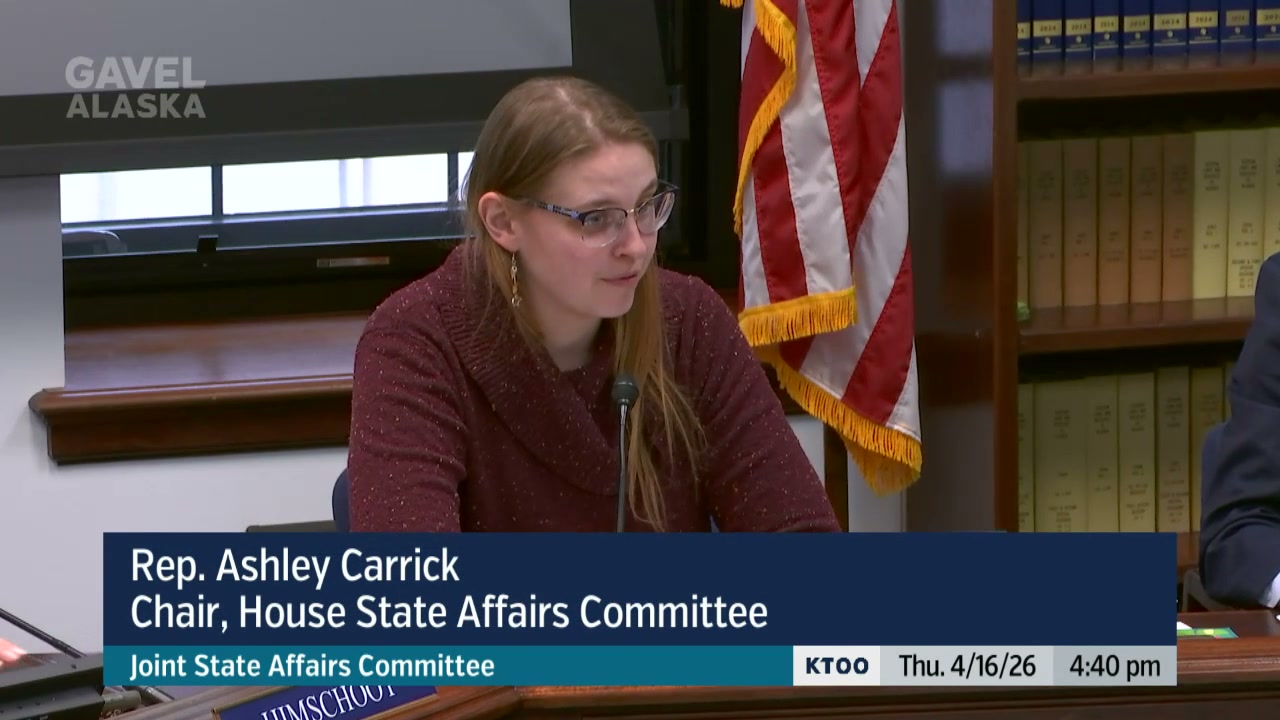
Frame from "Joint State Affairs, 4/16/26, 3:30pm" · Source
PublishedAI
Alaska lawmakers hear testimony on four ballot initiatives
by Alaska NewsApr 17, 2026(2w ago)5 min readJuneau
Share
The Alaska Legislature held a joint hearing Thursday to review three ballot initiatives that will appear before voters in November, along with testimony from one registered opposition group. The measures cover citizenship voting requirements, campaign finance limits, and the future of ranked choice voting.
The House and Senate State Affairs committees met in Juneau to fulfill a statutory requirement that standing committees host at least one hearing on each certified ballot initiative. The session drew testimony from initiative sponsors and the opposition group Protect Alaska's Elections, the only organization registered with the Alaska Public Offices Commission to oppose one of the measures.
Former state Senator John Coghill presented the United States Citizen Voting Act, which would explicitly limit voting to U.S. citizens. Coghill argued the measure addresses ambiguity in Alaska's Constitution, which states "every citizen of the United States may vote" but does not expressly say "only citizens may vote."
"The rules work best when they're explicit," Coghill said from North Pole. He pointed to a California court case where similar language was interpreted to allow noncitizen voting in local school board elections.
The initiative also responds to confusion affecting Alaska's Samoan American community. American Samoans hold U.S. national status rather than citizenship, which created complications under current voting law. "Confusion over the current system where the government of American Samoa chose decades ago for cultural and historical reasons that its people would be U.S. nationals rather than U.S. citizens collided with the way our voting laws are written," Coghill said.
Legislative Legal counsel Alpheus Bullard said the initiative would not substantively change state law. "I do not think that this initiative would change state law at all," Bullard testified.
Senator Wielechowski asked whether Coghill would support legislative action instead of a ballot measure. "I suppose so," Coghill responded. "I want this put into law, but it would be nice to have the people have to deal with it, showing that it is an important thing."
Bruce Botelho presented the campaign contribution limits initiative, which would restore caps invalidated in the Thompson v. Hebdon litigation. The measure sets individual contribution limits at $2,000 per candidate per election cycle and $4,000 for gubernatorial tickets.
"Alaska has had campaign limits for the majority of its life as a state," Botelho testified from Cordova. "The underlying philosophy behind such limits has been to protect the integrity of the democratic process by basically trying to prevent corruption or its appearance and curbing any undue influence of large donors."
This article was drafted with AI assistance and reviewed by editors before publishing. Every claim can be verified against the original transcript. If you spot an error, let us know.
The initiative adjusts limits for inflation every ten years through the Alaska Public Offices Commission. Botelho noted that 11 states currently have no contribution limits, while limits in other states range from $400 in Colorado to $11,000 in New York.
House Bill 16, which addresses similar issues, passed both State Affairs committees last session and awaits final action in the Senate. If substantially similar legislation passes, the ballot measure would be removed from the November ballot under constitutional requirements.
The hearing on the initiative to repeal ranked choice voting and open primaries drew extended questioning from lawmakers. Bethany Markham, treasurer for Repeal Now, contended the system creates "exhausted ballots" that do not count in final tallies.
"In the 2022 special congressional election there were nearly 15,000 Alaskan votes that were thrown out before Mary Peltola was declared the winner," Markham testified. She later clarified that "thrown out" referred to ballots that became ineffective in later rounds of tabulation, not physically discarded.
Senator Wielechowski pressed on the terminology. "Do you have any evidence that the Division of Elections actually threw ballots in the trash?" he asked.
Greg Powers, general consultant for Repeal Now, responded: "The point that we are making here is that these ballots are as good as trashed. If your vote does not count in another round, then what is the difference?"
Markham said the repeal would restore primaries open to undeclared voters and return to pre-2020 campaign finance laws. She cited a 2024 study by the Bipartisan Policy Group that categorized Alaska's former system as "open to unaffiliated" primaries.
Representative Himschoot questioned whether the initiative would allow parties to close primaries. "At any point the Democratic Party could write bylaws, or the Republican Party could write bylaws that close me as an unaffiliated or nonpartisan out of the primary if we go back to the old system. Is that correct?" she asked.
Markham acknowledged such closures were unlikely based on Alaska's history but said she could not speak for the parties.
Scott Kendall testified in opposition on behalf of Protect Alaska's Elections, the only APOC-registered opposition group. He argued the repeal would eliminate three major reforms: open primaries where every voter receives the same ballot, ranked choice voting that ensures majority winners, and strengthened campaign disclosure requirements including a ban on dark money.
"64 percent of Alaska's voters are not affiliated with either major party," Kendall testified from Anchorage. "They want a choice too, and this measure explicitly gives the parties the power to shut them out."
Kendall noted that the repeal would also eliminate provisions requiring $2,000 or more donations to be reported within 24 hours and would reduce fines for disclosure violations from the amount of the donation to $50 per day. He pointed to historical context, noting that a 2000 ballot measure proposing ranked choice voting had been supported by multiple Alaska political parties including the Republican Party.
Kendall disputed claims about ballot complexity and irregularities. He cited academic studies showing 83 percent of voters found ranked choice voting simple, with ballot spoilage rates no higher than under the previous system. "There has been zero evidence that there has been any irregularities whatsoever," he stated.
On the delay in results, Kendall argued the issue stems from the Division of Elections not preprocessing absentee ballots, not from ranked choice tabulation. "When the Director of Elections pushes the button, it takes mere seconds," he testified.
Representative McCabe noted a 1990s Alaska Supreme Court case that forced the Republican Party to open its primary. "Thinking or saying or indicating or opining that this will cause us to go back to a completely closed primary would sort of go against court precedent," he observed.
The hearing included no votes or formal action. The three ballot initiatives will appear on the November ballot regardless of legislative activity, though substantially similar legislation could remove an initiative from consideration.
Representative Carrick, who co-chaired the hearing with Senator Kawasaki, reminded members the session was informational only. "This is just an overview hearing," she noted. "These issues will be on the ballot either way."
The committees were joined by former Speaker Mike Chenault, who thanked the committee for the hearing. Legislative Legal staff Andrew Dunmire and Alpheus Bullard were available for legal questions.
The hearing was held in Room 106 of the state Capitol and concluded at 5:04 p.m.
Stay informed. Support what matters.
Free, permanent access to local news you can verify. Subscribe to support Alaska News and go ad-free.

Comments
Sign in to leave a comment.
No comments yet. Be the first to share your thoughts.