
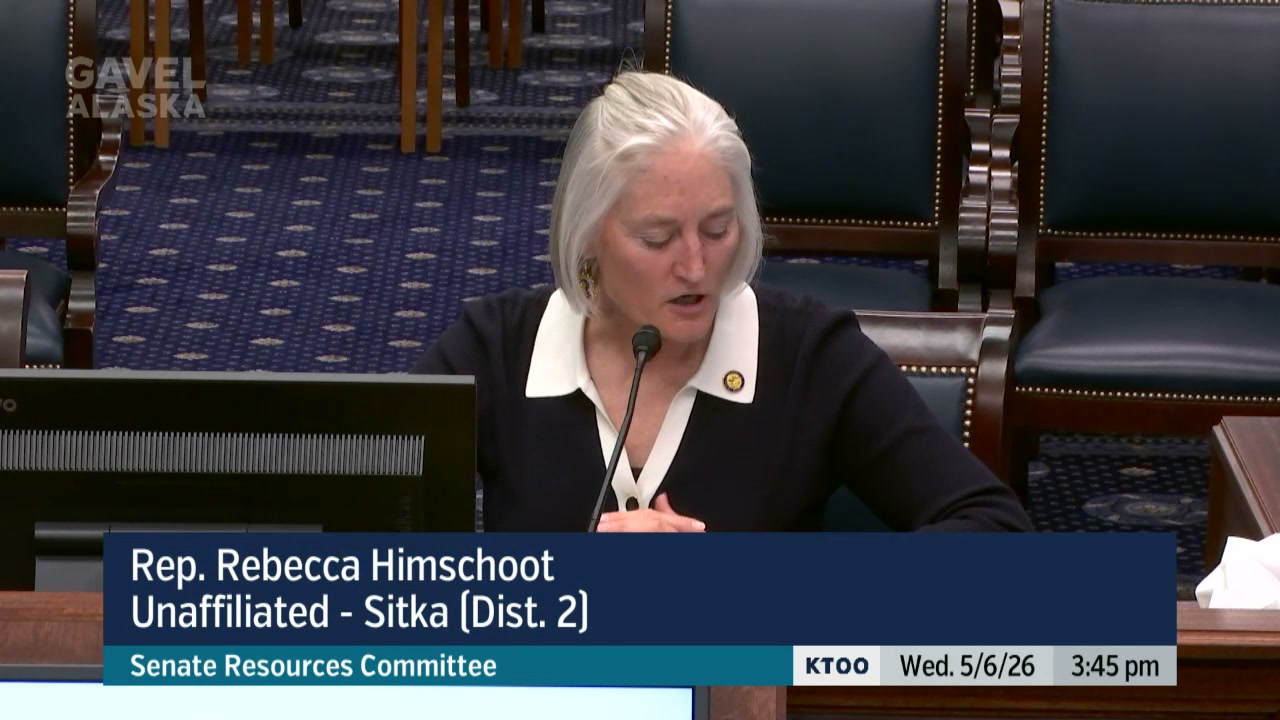
Frame from "Senate Resources, 5/6/26, 3:30pm" · Source
Alaska House bill would tighten hunting, fishing residency to 180 days
The Alaska Senate heard a bill Wednesday that would require Alaskans to spend at least 180 days in-state each year to qualify for resident hunting and fishing licenses.
House Bill 93, sponsored by Representative Rebecca Himschoot of Sitka, would align residency requirements for hunting and fishing with Permanent Fund Dividend eligibility rules, including a 180-day in-state requirement and allowable absences. The bill passed the Alaska House and is now under consideration in the Senate.
Current law allows resident licenses based on maintaining a home for 12 months, not claiming residency elsewhere, and intent to remain, without a specific day requirement. Himschoot said those standards create enforcement problems for Alaska State Troopers.
"Some of the questioned residency investigations can take as long, because of our complicated definitions, can take as long as a homicide investigation," Himschoot said.
About 118 questioned residencies are investigated per year on average, according to Himschoot. She said the bill would give troopers a clearer standard to enforce.
Resident licenses cost less and provide higher bag limits than nonresident licenses. The Alaska Board of Fish and Board of Game have expanded those preferences over the years, Himschoot said, but the state has not created an enforceable way to determine who qualifies.
"We have lower license fees and we also have higher bag limits for folks who hunt and fish as a resident," Himschoot said. "We want to recognize that the folks who are here with their kids in the schools, volunteering on their local EMS, shoveling snow, that those folks get more of the bounty of the state than folks who are visiting."
The bill includes the same allowable absences as PFD rules, including exemptions for military service members, students, and caregiving. Himschoot said the bill uses the PFD standard because it has been tested by the courts, and that allowable absences would track future PFD rule changes.
One difference between the dividend requirements and House Bill 93 is the 12 months in the dividend is clearly a calendar year, January to December. In House Bill 93, it is just 12 months. So if you come to Alaska in June, the following year in June, you would be eligible to hunt and fish as a resident.
The bill has a delayed effective date of January 2028.
"It has an effective date in January of '28. So people have all of next year to sort of sort themselves out and align themselves to the new standards," Himschoot said.
Senator George Rauscher questioned whether Alaskans who own homes, pay property taxes, and have families in-state but miss the 180-day threshold would lose resident privileges.
This article was drafted with AI assistance and reviewed by editors before publishing. Every claim can be verified against the original transcript. If you spot an error, let us know.
Comments
Sign in to leave a comment.
No comments yet. Be the first to share your thoughts.