Alaska bill would penalize state for late payments to contractors
by Alaska NewsMay 8, 2026(8h ago)4 min read1 viewsState Capitol, Juneau
Share
The Alaska Senate Finance Committee heard testimony Thursday on legislation that would penalize the state when it fails to pay nonprofits, municipalities, and tribal organizations on time.
House Bill 133 would extend existing prompt payment protections for private contractors to nonprofits, municipalities, and Alaska Native organizations. The bill would impose 10.5 percent interest on payments that exceed 30 days after satisfactory performance, matching the rate already required for private contractors on public works projects. The legislation applies to grants, contracts, and reimbursements.
Representative Rebecca Himschoot introduced the bill in March 2025 alongside companion legislation Senate Bill 129. The House State Affairs Committee advanced HB 133 in January 2026 after rejecting an amendment to exempt nonprofits. Private contractors working on public works have been protected since 1990 under state statute with interest payments if the state is late. The new bill would extend those protections to other state partners.
Systemic delays force organizations to use credit
Himschoot told the committee that organizations across Alaska routinely wait weeks, months, and in rare cases over a year for payment from the state for work that has been satisfactorily completed.
"The state's partners sometimes cannot make payroll, or they may have to take out a line of credit, draw on very limited reserves, and at times they even have to stop providing services," Himschoot said.
Stephanie Bushong, Transit Deputy Director for the Ketchikan Gateway Borough, testified that delayed payments have been a longstanding systemic issue across nearly two decades of her work in Alaska. She said municipal systems like Ketchikan's are effectively subsidizing the state by floating money that has already been approved.
"Executive directors and board members have personally funded payroll out of their own accounts or taken out lines of credit just to keep agencies open," Bushong said. "In some cases, organizations are using credit cards to cover the cost of capital projects because state payments are delayed for six months or more."
Lori Wolf, president and CEO of the Foraker Group, said late payments happen in almost every department and can range from three months to more than a year, with amounts from $25,000 to over $1 million.
Charles Westmoreland, Director of Business Development with Wostmann and Associates, said his firm sometimes has to bridge payment gaps using a line of credit backed by receivables. When an invoice is 60 or 90 days late, it often is no longer considered reliable collateral for borrowing.
This article was drafted with AI assistance and reviewed by editors before publishing. Every claim can be verified against the original transcript. If you spot an error, let us know.
The legislation would phase in compliance over three fiscal years. The state would start with a report on the first day of the 35th Legislature detailing any late payments, the cause for the delay, and the duration of the delay. In fiscal year 2028, the bill sets a standard of 45 days, then moves to the 30-day expectation in fiscal year 2029. Additionally, delayed payments would be recorded in the state's online open checkbook.
The bill includes an exception for federal funding delays. If the source of funding is not on time, the clock does not start ticking until that money has arrived, Himschoot said.
Department of Health faces volume and complexity challenges
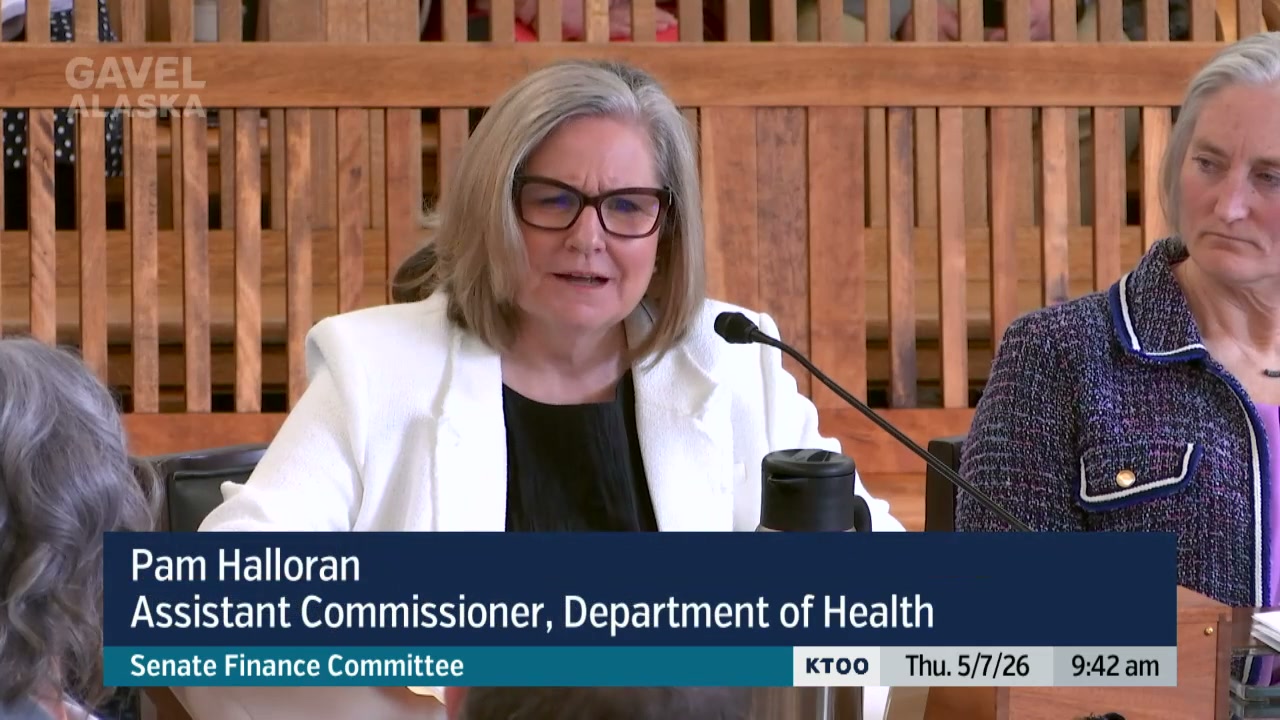
Pam Halloran, Assistant Commissioner for the Department of Health, told the committee that turnover, training, and the complexity of the accounting system contribute to late payments. The department manages over 200 federal programs and those are very complex to manage within the accounting system, she said.
"We have over 448 grants. We have 295 contracts that we are managing at any given time," Halloran said.
She said the department is working to improve timely payments by accepting seven positions through the Shared Services of Alaska deconsolidation, providing one position for each division. The department is also producing monthly scorecards with trend lines so staff can see where they are at.
Halloran said there are some pieces of the legislation that will be difficult to track the way the accounting system is built now because the system does not have a field for satisfactory performance.
Fiscal notes total just under $1.1 million
Senator Jesse Kiehl reviewed the fiscal notes for the committee. He said the fiscal notes with fiscal impact total just under $1.1 million in eight full-time positions.
The Department of Health submitted six fiscal notes. Some divisions estimated that penalties would be cheaper than adding a position. The Behavioral Health Administration estimated it will pay $26,400 going up to $30,000 in the out years in penalties, all unrestricted general funds. Senior and Disability Services Administration estimated about $19,000 in unrestricted general funds.
Other divisions added positions. Medical Assistance Administration, Public Assistance Administration, and Public Health Admin Services each estimated costs of $93,800 in year one and $159,500 going forward for one full-time position, with varying splits between federal receipts and general fund match.
The Department of Military and Veterans Affairs estimated a cost of $458,400, including $114,600 in general funds and the same in interagency funds, with $229,200 in CIP receipts.
Several departments submitted zero fiscal notes, including the Department of Administration, Commerce Community and Economic Development, Family and Community Services, Fish and Game, Labor and Workforce Development, Department of Law, Natural Resources, and Public Safety. Hannah Lager, Administrative Services Director for the Department of Commerce, Community and Economic Development, said 97 percent of the department's payments fall within 30 days of invoice date, and most are paid within two weeks.
The committee took no action on the bill. The Senate Finance Committee will consider the legislation at a future meeting.
Stay informed. Support what matters.
Free, permanent access to local news you can verify. Subscribe to support Alaska News and go ad-free.

Comments
Sign in to leave a comment.
No comments yet. Be the first to share your thoughts.