
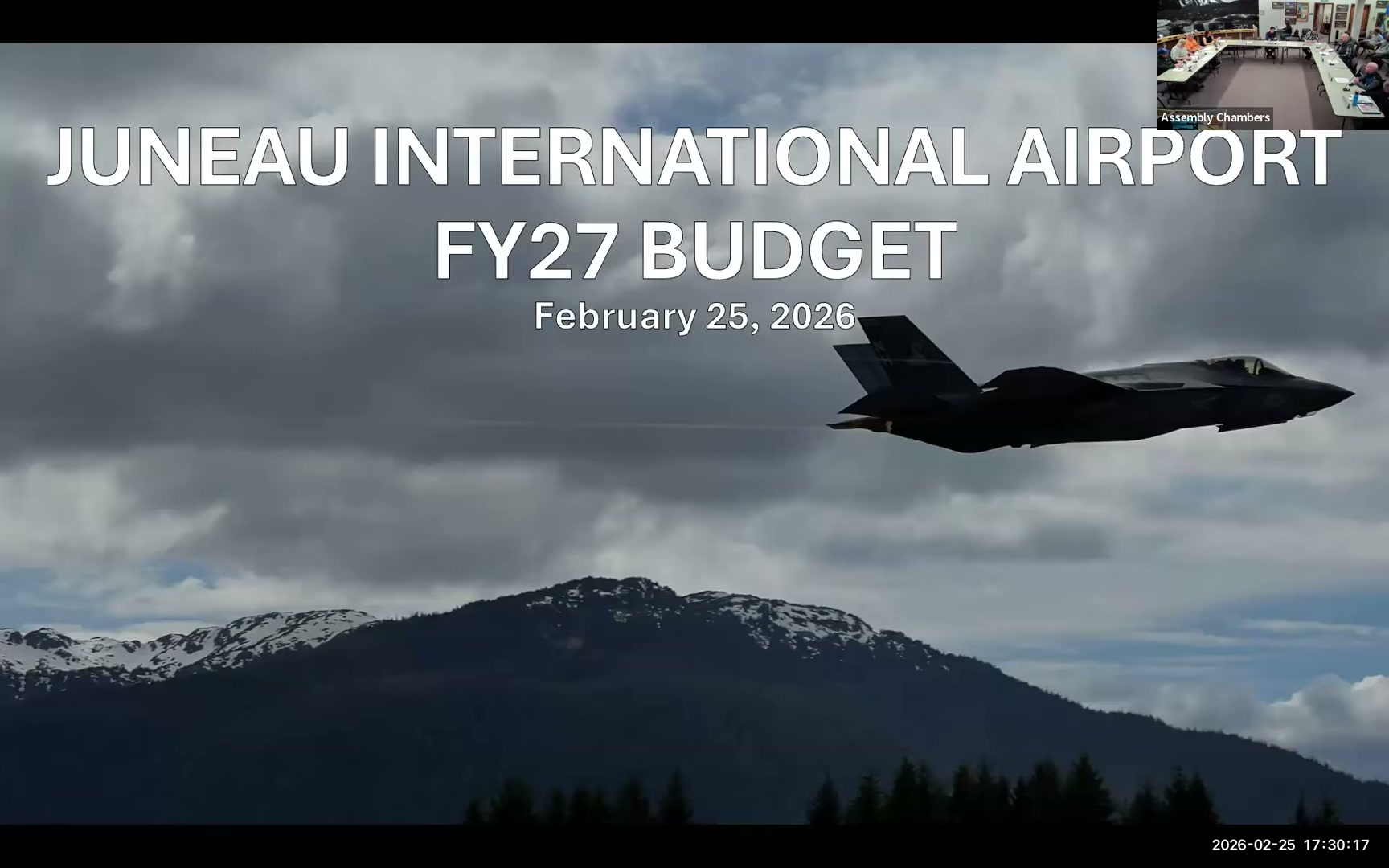
Frame from "February 25, 2026 Special Joint Assembly Finance Committee with Airport & Hospital Boards" · Source
Airport firefighting trucks fail, leaving Juneau one flat tire from losing all flights
Juneau International Airport came within one flat tire of losing all commercial air service this month when two of its three firefighting trucks failed simultaneously, exposing dangerous reliance on borrowed equipment and prompting urgent requests for emergency funding.
The airport dropped to Index B status when both its 2016 truck and a leased truck from Palmer experienced turret failures during required testing. That left only a borrowed 2014 truck from Gustavus in service, limiting Juneau to accepting only Alaska Airlines' 737-700s, which the carrier is phasing out. Had that remaining truck suffered even a flat tire, the airport would have hit Index Zero status, meaning no commercial flights at all.
"Without these trucks, we are not allowed to operate as an airport," Airport Manager Andres Delgado said. "This is extremely important to the community and to the safety of the community as a whole."
The crisis exposed a fleet two-thirds owned by other communities. Juneau's newest truck dates to 2016. Its 2003 model is permanently out of service, and a 1992 model has been surplused. The airport now relies on the Palmer lease and the Gustavus loan to maintain the three trucks required for Index C operations, which allow the airport to handle the 737 MAX 9s and 800s that make up most Alaska Airlines service.
The borrowed Gustavus truck must return by May 1. A new truck scheduled to arrive in late April will not enter service until June or early July after Capital City Fire Rescue personnel complete training and certification. That leaves a gap when Juneau will again depend on just two aging trucks, the same two that failed this month.
"We just cannot afford that," Airport Board Vice Chair David Epstein said. "We cannot have a capital city with an airport that is not capable of accepting air carrier service when we have a hiccup in one operational vehicle."
When both trucks went down, airport staff scrambled to find replacement parts no longer manufactured. The airport sent personnel to South Carolina to retrieve parts and deliver them to Juneau to complete repairs as quickly as possible. Alaska Airlines coordinated to make service work with only Index B capability, but the limitations were severe.
"If we went down to ARFF Zero in May or June, that will be during the travel season," Airport Board Chair Eve Soutier said, calling in from Colorado where she was recovering from surgery. "That will be during everybody wants to go out and travel and we have a whole bunch of tourists coming in to travel. If we go to ARFF Zero, they will not be coming in. The legislators will also not be going out."
The Federal Aviation Administration will not fund a replacement truck until 2031. The agency told airport officials their trucks are projected to be in poor condition by then, but current fleet status meets minimum requirements, even though two-thirds of that fleet belongs to other communities.
This article was drafted with AI assistance and reviewed by editors before publishing. Every claim can be verified against the original transcript. If you spot an error, let us know.
Related Coverage
Alaska DOT seeks snow removal equipment for statewide airports
Alaska News · 6d ago · 4 views · 75% match
Alaska DOT files five equipment bids for snow blowers, paint trucks, road maintenance gear
Alaska News · 1d ago · 1 views · 72% match
State seeks bids for airport snow removal equipment statewide
Alaska News · 1w ago · 2 views · 72% match
Alaska lawmakers hear warnings of rural fuel crisis, weigh loan program expansion
Alaska News · 4d ago · 5 views · 72% match
Hundreds pack Juneau Assembly meeting to oppose recreation facility cuts
Alaska News · 12h ago · 2 views · 71% match
Comments
Sign in to leave a comment.
No comments yet. Be the first to share your thoughts.